
Bookmaker Margin Explained: How to Spot a Bad Price
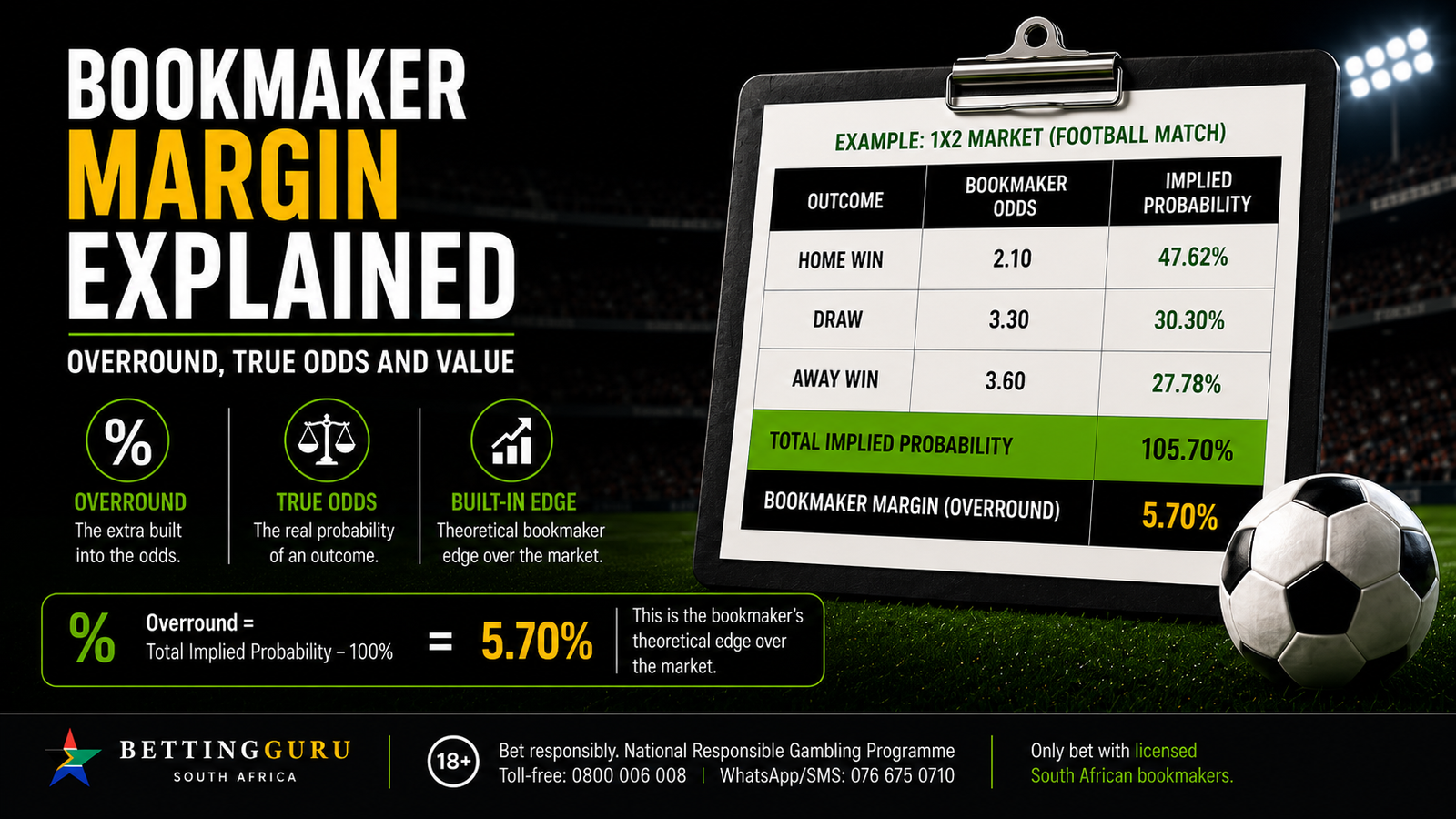
Bookmaker margin is the pricing advantage built into a betting market. It is commonly estimated by converting every offered price into an implied probability, adding those percentages together and measuring how far the total exceeds 100%.
The result is often called the overround. A lower overround generally indicates more competitive prices, but it does not tell you which individual selection is good value or guarantee how much profit a bookmaker will make.
Article contents
What Is Bookmaker Margin?
In a perfectly fair market, the probabilities of every mutually exclusive outcome would add to exactly 100%. Bookmakers normally offer prices whose implied probabilities total more than 100%.
The difference above 100% is the market’s overround. It is a useful indication of the amount of pricing room built into the market before individual betting activity, liabilities, promotions and operating costs are considered.
How to Calculate Bookmaker Margin
For decimal odds, first convert each price into an implied probability:
Then add all outcomes and subtract 100%.
- List every possible outcome in the market.
- Divide 1 by each decimal price.
- Convert each answer to a percentage.
- Add the percentages.
- Subtract 100% to obtain the overround.
Worked Example: Three-Way Football Market
Assume a bookmaker offers these normal-time prices:
| Outcome | Decimal odds | Calculation | Implied probability |
|---|---|---|---|
| Home win | 2.10 | 1 ÷ 2.10 | 47.62% |
| Draw | 3.40 | 1 ÷ 3.40 | 29.41% |
| Away win | 3.50 | 1 ÷ 3.50 | 28.57% |
| Total | — | 47.62 + 29.41 + 28.57 | 105.60% |
This calculation measures the whole market. It does not prove that the margin is distributed equally across the home win, draw and away win.
Worked Example: Two-Way Market
Suppose both sides of a market are offered at 1.91:
| Selection | Implied probability | Calculation |
|---|---|---|
| Selection A at 1.91 | 52.36% | 1 ÷ 1.91 × 100 |
| Selection B at 1.91 | 52.36% | 1 ÷ 1.91 × 100 |
| Total | 104.71% | Overround: 4.71% |
If each side had a true 50% chance, fair decimal odds would be 2.00 rather than 1.91.
How to Remove the Margin and Estimate Fair Probabilities
A simple proportional method divides each implied probability by the total market percentage. This is often called normalising the market.
| Outcome | Raw implied probability | Normalised probability | Approximate fair odds |
|---|---|---|---|
| Home win | 47.62% | 45.09% | 2.22 |
| Draw | 29.41% | 27.85% | 3.59 |
| Away win | 28.57% | 27.06% | 3.70 |
Proportional normalisation is a convenient estimate, not proof of the bookmaker’s internal probability model. More advanced methods may account for favourite–longshot bias or uneven margin allocation.
Bookmaker Margin vs House Edge
| Concept | Usually used for | What it measures |
|---|---|---|
| Overround | Sports betting markets | How far the listed implied probabilities exceed 100% |
| Hold | Bookmaker financial results | Actual revenue retained relative to stakes over a period |
| House edge | Casino games | Long-run expected loss built into a game’s rules |
These ideas are related but not interchangeable. Our House Edge Calculator applies to casino-style expected loss, while overround is a pricing measure for a complete betting market.
Why Do Bookmaker Margins Vary?
- Market popularity: major football match-result markets often have more competition and liquidity.
- Market complexity: player props and niche statistics may carry wider pricing margins.
- Timing: early prices may be less mature than prices close to the event.
- Information risk: uncertain line-ups or limited data can lead to wider prices.
- Promotion structure: boosts, bonuses and enhanced multiples can change the effective price.
- Operator strategy: bookmakers may price the same event differently.
How to Compare Bookmaker Margins
Compare the same market, event and settlement period across operators. A 1X2 normal-time market should not be compared with a to-qualify market or draw-no-bet price.
Match the market
Confirm that every bookmaker is pricing the identical outcome and settlement period.
Calculate the full book
Use every outcome, not only the selection you plan to back.
Check limits and rules
A better price may have different maximum stakes, void rules or promotional conditions.
Shop for the selection
The lowest overall margin does not guarantee the best individual price on your chosen outcome.
Bookmaker Margin, Fair Odds and Value
A bettor is not trying to remove the bookmaker’s entire margin. The practical question is whether the offered price is higher than the bettor’s own defensible estimate of fair odds.
If you estimate a 45% chance, the corresponding fair odds are:
An available price above 2.22 may represent positive expected value under that estimate. A price below 2.22 does not.
Continue with our Implied Probability Explained and Value Betting Explained guides.
Frequently Asked Questions About Bookmaker Margin
What is bookmaker margin?
It is the pricing advantage built into a market. It is commonly estimated by adding the implied probabilities of every outcome and subtracting 100%.
What is overround?
Overround is the amount by which a market’s total implied probability exceeds 100%.
Is a lower bookmaker margin always better?
Lower overround generally indicates more competitive overall pricing, but you should still compare the exact price on your chosen selection and check the market rules.
Does a 5% overround mean the bookmaker earns 5%?
No. Overround is a pricing measure, not guaranteed realised profit. Actual hold depends on stakes, outcomes, liabilities and adjustments.
How do I calculate fair odds?
Divide 1 by your estimated probability expressed as a decimal. A 40% estimate corresponds to fair odds of 2.50.
Can a market have an overround below 100%?
Yes, temporarily or across prices taken from different bookmakers. A single operator may also offer promotional prices that create an apparent underround, subject to limits and terms.
South African Betting and Licensing
Online betting is legal when it is offered by a bookmaker licensed in South Africa and used by a person aged 18 or older. Verify an operator through the relevant provincial licensing authority or the National Gambling Board’s verified-operator portal.
Responsible Betting
Understanding bookmaker margin can help explain how betting prices and features work, but it cannot make an uncertain outcome guaranteed. Set a fixed budget, use stakes you can afford to lose and never chase losses.
Free and confidential support is available through the South African Responsible Gambling Foundation. Call 0800 006 008 or WhatsApp/SMS HELP to 076 675 0710.
Gambling is for adults aged 18 and over only. Please gamble responsibly.
Sources and Useful Links
- BettingGuru SA – How to Read Sports Betting Odds
- BettingGuru SA – Sports Betting Terms Explained
- BettingGuru SA – Implied Probability Explained
- BettingGuru SA – Value Betting Explained
- BettingGuru SA – Dutching Calculator
- National Gambling Board – Verified Operators
- National Gambling Board – Gambling FAQs
- South African Responsible Gambling Foundation
BettingGuru SA Disclaimer
BettingGuru SA is an independent betting information and comparison platform. This article is provided for educational purposes and does not guarantee winnings or constitute legal, financial or professional advice. Odds, markets, calculations, features and operator rules can change. Check the current bookmaker terms before placing a bet. 18+ only. Please gamble responsibly.