
Implied Probability Explained: Convert Betting Odds to Percentages
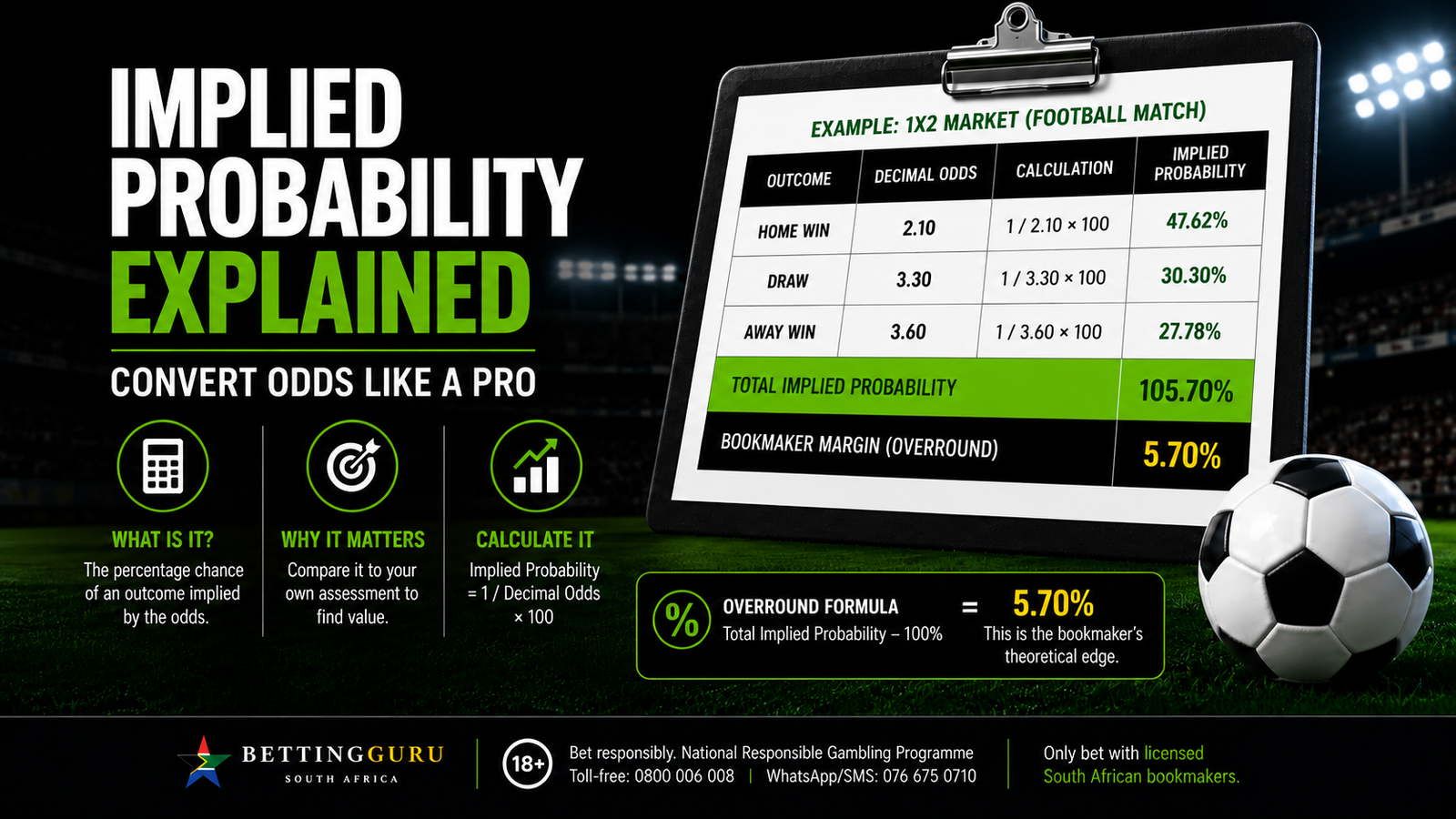
Implied probability converts betting odds into the percentage chance represented by a price. Decimal odds of 2.00 imply 50%, odds of 4.00 imply 25%, and odds of 10.00 imply 10% before considering the bookmaker margin.
The calculation helps bettors compare prices, identify break-even points and understand why a high potential payout usually represents a lower implied chance.
Article contents
What Is Implied Probability?
Implied probability is the break-even probability built into the odds. If a selection is offered at 2.00, a bettor would need to win 50% of identical bets at that price to break even before other costs.
It is not necessarily the true chance of the outcome. The price may include bookmaker margin, market opinion, trading adjustments and new information.
Odds
The price that determines the potential payout.
Implied probability
The break-even percentage represented by that price.
Estimated probability
Your evidence-based assessment of the outcome’s chance.
Fair odds
The decimal price corresponding to an estimated probability without margin.
Decimal Odds to Implied Probability
Example: Decimal Odds of 2.50
A R100 cash bet at 2.50 has a potential payout of R250. The price represents a 40% break-even probability.
Decimal Odds and Probability Table
| Decimal odds | Implied probability | R100 potential payout | R100 profit if successful |
|---|---|---|---|
| 1.25 | 80.00% | R125 | R25 |
| 1.50 | 66.67% | R150 | R50 |
| 2.00 | 50.00% | R200 | R100 |
| 2.50 | 40.00% | R250 | R150 |
| 3.00 | 33.33% | R300 | R200 |
| 4.00 | 25.00% | R400 | R300 |
| 5.00 | 20.00% | R500 | R400 |
| 10.00 | 10.00% | R1,000 | R900 |
Fractional Odds to Implied Probability
For fractional odds written as A/B:
For 3/1:
Fractional odds of 3/1 are equivalent to decimal odds of 4.00.
American Odds to Implied Probability
Positive American Odds
For +300:
Negative American Odds
For −150:
South African bookmakers usually display decimal prices, but these conversions are useful when reading international content.
Convert Probability Into Fair Decimal Odds
| Estimated probability | Calculation | Fair decimal odds |
|---|---|---|
| 70% | 1 ÷ 0.70 | 1.43 |
| 60% | 1 ÷ 0.60 | 1.67 |
| 50% | 1 ÷ 0.50 | 2.00 |
| 40% | 1 ÷ 0.40 | 2.50 |
| 25% | 1 ÷ 0.25 | 4.00 |
| 10% | 1 ÷ 0.10 | 10.00 |
Why Do Market Probabilities Add to More Than 100%?
When every offered outcome is converted, the total usually exceeds 100% because the prices contain a bookmaker margin.
Consider a two-way market priced at 1.91 on each side:
The extra 4.71 percentage points are the market overround. Read Bookmaker Margin Explained for a complete calculation.
How to Estimate No-Vig or Fair Market Probabilities
A basic proportional method divides each raw implied probability by the market total.
In the 1.91 versus 1.91 example:
Each side normalises to approximately 50%. This method assumes the margin is distributed proportionally, which may not reflect the exact pricing model.
Common Implied-Probability Mistakes
- Treating implied probability as certainty: 70% still includes a 30% chance of losing under the estimate.
- Ignoring bookmaker margin: raw probabilities across a market commonly exceed 100%.
- Mixing formats: 2.50 decimal odds are not the same as 2/5 fractional odds.
- Using rounded figures too early: rounding every outcome can distort the total.
- Comparing different markets: normal-time, to-qualify and handicap prices represent different outcomes.
- Assuming your estimate is objective: a personal probability remains an estimate and can be wrong.
How Implied Probability Supports Better Decisions
- Convert the offered price into a break-even percentage.
- Estimate the outcome independently using relevant information.
- Compare your estimate with the break-even percentage.
- Account for uncertainty and estimation error.
- Use controlled stakes rather than treating a small perceived edge as certainty.
Our Value Betting Explained guide shows how probability estimates connect to expected value, while the Kelly Criterion Calculator demonstrates how sensitive staking recommendations are to estimation errors.
Frequently Asked Questions About Implied Probability
What is implied probability?
It is the break-even probability represented by betting odds.
What probability is decimal odds of 2.00?
50%, calculated as 1 divided by 2.00 multiplied by 100.
What probability is odds of 3.00?
Approximately 33.33%.
Why do bookmaker probabilities exceed 100%?
Because the offered prices normally contain a bookmaker margin or overround.
Is implied probability the true probability?
No. It is the percentage represented by the price. The true probability is uncertain and must be estimated.
How do I convert probability to odds?
Divide 1 by the probability expressed as a decimal. A 40% probability gives fair odds of 2.50.
South African Betting and Licensing
Online betting is legal when it is offered by a bookmaker licensed in South Africa and used by a person aged 18 or older. Verify an operator through the relevant provincial licensing authority or the National Gambling Board’s verified-operator portal.
Responsible Betting
Understanding implied probability can help explain how betting prices and features work, but it cannot make an uncertain outcome guaranteed. Set a fixed budget, use stakes you can afford to lose and never chase losses.
Free and confidential support is available through the South African Responsible Gambling Foundation. Call 0800 006 008 or WhatsApp/SMS HELP to 076 675 0710.
Gambling is for adults aged 18 and over only. Please gamble responsibly.
Sources and Useful Links
- BettingGuru SA – How to Read Sports Betting Odds
- BettingGuru SA – Bookmaker Margin Explained
- BettingGuru SA – Value Betting Explained
- BettingGuru SA – Kelly Criterion Calculator
- BettingGuru SA – Sports Betting Markets Explained
- National Gambling Board – Verified Operators
- National Gambling Board – Gambling FAQs
- South African Responsible Gambling Foundation
BettingGuru SA Disclaimer
BettingGuru SA is an independent betting information and comparison platform. This article is provided for educational purposes and does not guarantee winnings or constitute legal, financial or professional advice. Odds, markets, calculations, features and operator rules can change. Check the current bookmaker terms before placing a bet. 18+ only. Please gamble responsibly.