Spain Win the 2026 FIFA World Cup After Extra-Time Victory Over Argentina
Spain Win the 2026 FIFA World Cup After Extra-Time against Argentina with 1-0
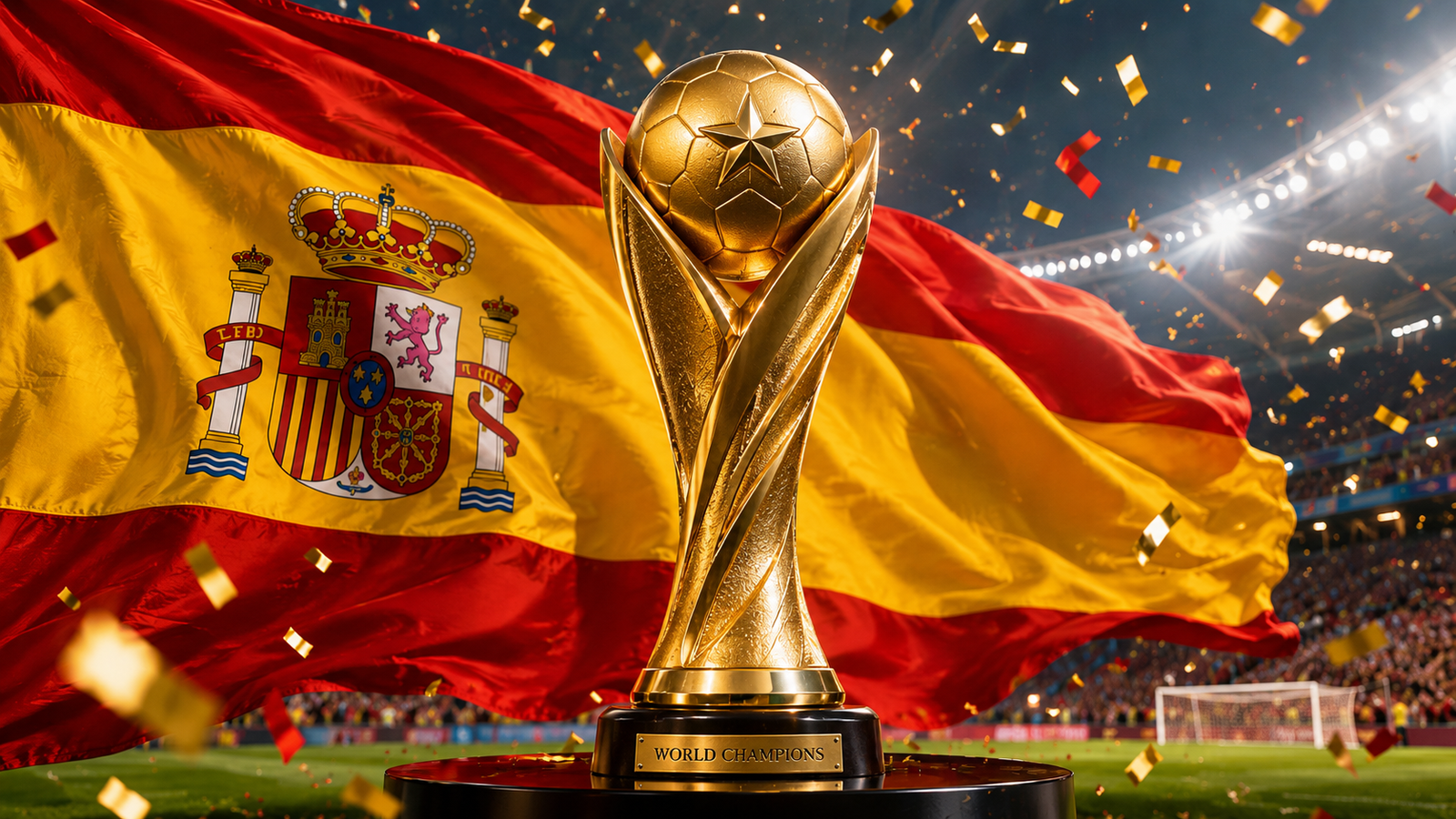
Spain win the 2026 World Cup after defeating defending champions Argentina 1-0 following extra time in the final at New York New Jersey Stadium in East Rutherford on Sunday, 19 July 2026. Substitute Ferran Torres scored the only goal in the 106th minute, ending Argentina’s title defence and delivering Spain’s second men’s World Cup trophy, 16 years after their first triumph in South Africa. The result completed the FIFA World Cup 2026 and returned La Roja to the top of men’s international football.
The final score was narrow, but the match itself was largely controlled by Spain. Luis de la Fuente’s side dominated possession, territory and chances, while Argentina relied on the outstanding goalkeeping of Emiliano Martínez to remain level through 90 minutes. When Enzo Fernández was sent off in stoppage time, Spain entered extra time with a numerical advantage and eventually converted their superiority into the goal that decided the tournament. For more results, reports and award coverage, visit our World Cup 2026 hub.
Spain Win the 2026 World Cup: Final at a Glance
| Competition | 2026 FIFA World Cup final |
|---|---|
| Date | Sunday, 19 July 2026 |
| Venue | New York New Jersey Stadium (MetLife Stadium), East Rutherford, USA |
| Result | Spain 1-0 Argentina after extra time |
| Half-time | 0-0 |
| After 90 minutes | 0-0 |
| Goal scorer | Ferran Torres, 106th minute |
| Red card | Enzo Fernández, Argentina, second yellow in second-half stoppage time |
| Post-match red card | Leandro Paredes, Argentina, after the final whistle |
| Referee | Slavko Vinčić of Slovenia |
| Spain captain | Rodri |
| Argentina captain | Lionel Messi |
| World Cup titles | Spain’s second title, following 2010 |
Spain Control the Final Without Finding an Early Goal
Spain began the final with the confidence of a team that had developed into the tournament’s most complete side. Rodri dictated the rhythm from midfield, while Dani Olmo and Fabián Ruiz helped La Roja circulate the ball around Argentina’s compact defensive shape. Lamine Yamal remained a constant threat from the right, and Marc Cucurella and Pedro Porro pushed forward from full-back whenever Spain created space.
Argentina defended deeper than usual and looked to protect the central areas in front of Emiliano Martínez. Lionel Messi and Julián Álvarez were left with limited opportunities to counterattack because Spain recovered the ball quickly and rarely allowed the defending champions to build sustained possession. Argentina did not register a first-half attempt, while Spain repeatedly tested Martínez from distance and through combinations around the penalty area.
Spain’s pressure continued after the interval. Martínez produced save after save to keep Argentina in the match, and the longer the score remained 0-0, the more the final appeared to be moving toward extra time or penalties. De la Fuente reacted in the 62nd minute by introducing Pedri and Ferran Torres for Fabián Ruiz and Mikel Oyarzabal. Nico Williams and Mikel Merino later replaced Álex Baena and Dani Olmo, giving Spain additional speed and physical presence around the box. For a look back at how the matchup was assessed before kick-off, revisit our Spain vs Argentina betting tips.
Enzo Fernández Red Card Changes the Final
The decisive disciplinary moment arrived in second-half stoppage time. Enzo Fernández, who had already been booked, received a second yellow card after a reckless challenge on Pau Cubarsí. Argentina were reduced to 10 players just before extra time, forcing Lionel Scaloni’s team to defend the additional 30 minutes with one fewer midfielder.
Spain immediately increased the pressure. Nico Williams briefly appeared to have scored early in extra time, but the goal was disallowed for a foul by Mikel Merino in the build-up. The decision delayed the breakthrough, but Spain continued to attack rather than settling for a penalty shootout.
How did Spain Win the 2026 World Cup in Extra Time
The winning moment arrived in the 106th minute, only seconds after the second period of extra time began. Pedro Porro delivered the ball into the penalty area, Nico Williams helped direct it back into the danger zone, and Ferran Torres attacked the loose ball. The substitute struck left-footed beneath the crossbar, finally beating Martínez and sending the Spanish players and supporters into celebration.
It was Torres’s first goal of the tournament and unquestionably the most important of his international career. Spain had produced the first 20 attempts of the final before Argentina finally created a shot of their own late in extra time. Martínez’s performance had kept the score level for more than 100 minutes, but even the Argentina goalkeeper could not stop Torres’s decisive finish.
Argentina’s Late Push Falls Short
Argentina responded with their most dangerous spell after falling behind. Messi tried to force openings from set pieces and deeper positions, while substitute Giuliano Simeone had a major chance in the closing moments but sent his effort over the crossbar. Spain protected the penalty area, kept the ball whenever possible and survived the final wave of pressure to complete a historic victory. After the final whistle, Argentina midfielder Leandro Paredes was also shown a red card following a confrontation with Spain’s substitutes.
The defeat ended Argentina’s attempt to become the first men’s national team since Brazil in 1962 to retain the World Cup. It also brought an emotional conclusion to what may have been Messi’s final appearance at the tournament. The 39-year-old captain had hoped to follow the 2022 triumph in Qatar with another title, but Argentina were outplayed by a Spanish team that combined technical control with the strongest defence at the competition.
Video: Spain Win the 2026 FIFA World Cup After Extra, Source: SportyTV
Key Match Statistics
Match-stat providers reported slightly different figures. ESPN listed 67% possession, 20 total attempts and 11 shots on target for Spain; Reuters reported 20 attempts and 12 on target. AP credited Emiliano Martínez with a World Cup final-record 12 saves, while The Guardian listed 11. The undisputed overall picture was that Spain dominated the final and Argentina recorded two attempts and no shots on target.
| Statistic | Spain | Argentina |
|---|---|---|
| Possession (ESPN) | 67% | 33% |
| Total attempts (FIFA/Reuters/ESPN) | 20 | 2 |
| Shots on target (ESPN) | 11 | 0 |
| First attempt | Spain produced the first 20 attempts | First attempt came in the 115th minute |
| Goalkeeper highlight | Unai Simón kept a clean sheet | Martínez: 11 saves (Guardian) or 12 (AP); AP described 12 as a final record |
| Red cards during play | 0 | 1 – Enzo Fernández |
Starting Line-ups
Spain (4-2-3-1)
Unai Simón; Pedro Porro, Pau Cubarsí, Aymeric Laporte, Marc Cucurella; Rodri (captain), Fabián Ruiz; Lamine Yamal, Dani Olmo, Álex Baena; Mikel Oyarzabal.
Argentina (4-4-2)
Emiliano Martínez; Gonzalo Montiel, Cristian Romero, Lisandro Martínez, Nicolás Tagliafico; Rodrigo De Paul, Enzo Fernández, Alexis Mac Allister, Nicolás González; Lionel Messi (captain), Julián Álvarez.
Notable Spain substitutions
- 62nd minute: Ferran Torres replaced Mikel Oyarzabal.
- 62nd minute: Pedri replaced Fabián Ruiz.
- 75th minute: Nico Williams replaced Álex Baena.
- 75th minute: Mikel Merino replaced Dani Olmo.
- 99th minute: Martín Zubimendi and Eric García replaced Rodri and Aymeric Laporte.
Spain Win the 2026 World Cup: Road to the Title
| Stage | Result |
|---|---|
| Group H | Spain 0-0 Cape Verde |
| Group H | Spain 4-0 Saudi Arabia |
| Group H | Uruguay 0-1 Spain |
| Round of 32 | Spain 3-0 Austria |
| Round of 16 | Portugal 0-1 Spain |
| Quarter-final | Spain 2-1 Belgium |
| Semi-final | Spain 2-0 France |
| Final | Spain 1-0 Argentina after extra time |
Spain finished the tournament unbeaten and conceded only one goal in eight matches. Their defensive record set a new benchmark for a World Cup-winning team, while the victory extended Spain’s unbeaten international run to 38 matches.
Spain’s Second World Cup Creates New Records
Spain’s first men’s World Cup title came in 2010, when Andrés Iniesta scored in extra time against the Netherlands in Johannesburg. Sixteen years later, the winning pattern was repeated: another 1-0 final, another extra-time goal and another midfielder or forward entering Spanish football history with the decisive strike.
The 2026 triumph also made Spain the first nation to hold the men’s and women’s FIFA World Cup titles at the same time, following the Spanish women’s victory in 2023. Luis de la Fuente, aged 65, became the oldest head coach to guide a team to the men’s World Cup title.
Spain’s success confirmed the national team’s return to the top of international football after winning UEFA Euro 2024. The side combined experienced leaders such as Rodri, Aymeric Laporte and Dani Olmo with a young generation led by Lamine Yamal, Nico Williams and Pau Cubarsí.
Individual Awards for Spain
- Golden Ball: Rodri – best player of the tournament
- Golden Glove: Unai Simón – best goalkeeper
- Best Young Player: Pau Cubarsí
These awards reflected the balance of Spain’s winning team. Rodri controlled matches from midfield, Simón led a defence that conceded only once, and Cubarsí emerged as one of the tournament’s outstanding young defenders.
Why Spain Win 2026 World Cup Was Deserved
Spain’s title was built on more than possession. La Roja pressed immediately after losing the ball, defended with discipline and showed patience against opponents who played with deep defensive blocks. They could win comfortably, as they did against Saudi Arabia and Austria, but they also proved capable of surviving tight knockout matches against Portugal, Belgium and Argentina.
The final demonstrated every part of that identity. Spain controlled the ball, prevented Argentina from counterattacking, trusted their substitutes and continued attacking after a disallowed goal. Ferran Torres may have scored the winner, but the victory was the result of a complete team performance across 120 minutes and the entire tournament.
Frequently Asked Questions
How did Spain win the 2026 World Cup?
Spain controlled possession and chances before Ferran Torres scored in the 106th minute to secure a 1-0 extra-time victory over Argentina.
Who scored in the 2026 World Cup final?
Ferran Torres scored the only goal in the 106th minute.
What was the Spain vs Argentina final score?
Spain beat Argentina 1-0 after extra time. The match was 0-0 after 90 minutes.
Where was the 2026 World Cup final played?
The final was played at New York New Jersey Stadium, also known as MetLife Stadium, in East Rutherford, New Jersey.
How many World Cups have Spain won?
Spain have won two men’s FIFA World Cups: 2010 and 2026.
Was Lionel Messi in the 2026 World Cup final?
Yes. Messi captained Argentina at the age of 39 in what may have been his final World Cup appearance.
Who was sent off in the final?
Argentina midfielder Enzo Fernández was sent off after receiving a second yellow card in second-half stoppage time.
Conclusion
Spain win the 2026 World Cup and return to the summit of men’s international football. Their 1-0 extra-time victory over Argentina completed an unbeaten campaign defined by control, defensive excellence and a clear football identity. Ferran Torres’s 106th-minute goal will be remembered alongside Andrés Iniesta’s strike in 2010 as one of the greatest moments in Spanish football history.
Argentina and Lionel Messi made Spain work for the trophy, but the final confirmed what the tournament had already suggested: La Roja were the strongest and most complete team at the 2026 FIFA World Cup. South African readers who compare licensed bookmakers can also consult our guide to the best sports betting sites in South Africa. Betting is for adults aged 18 and over; please gamble responsibly.
BettingGuru SA Disclaimer
BettingGuru SA is an independent betting review and comparison platform. These Spain vs Argentina betting tips are for informational and entertainment purposes only. Odds and markets can change quickly and may differ between operators. We may receive commission from selected betting partners, but this does not affect our editorial independence. Please gamble responsibly. 18+ only.
Sources: FIFA.com | Associated Press | Royal Spanish Football Federation | Argentine Football Association | South African Responsible Gambling Foundation