
Dutching in Betting Explained: Formula & Examples
Dutching in Betting Explained
Dutching in betting is a staking method that divides one total stake across two or more mutually exclusive outcomes. The stakes are weighted according to the decimal odds so that each selected winner produces approximately the same gross return.
Quick answer
Dutching does not predict a winner and does not automatically create profit. It redistributes the total stake. If the combined implied probability is above 100%, equal Dutching normally creates a small loss. If it is below 100% and every possible outcome is covered, the prices may create a positive margin before rounding and betting restrictions.
In this guide
What Is Dutching in Betting?
Dutching is used when a bettor wants to back more than one possible result instead of placing the entire stake on one selection. Rather than using equal stakes, the method places a larger amount on the shorter-priced outcome and a smaller amount on the longer-priced outcome.
The objective is usually an equal gross return. For example, if two tennis players are priced at different odds, a Dutching calculation can show how to divide R200 so that either player produces nearly the same payout. The result can still be a loss because bookmaker odds normally contain a margin.
Dutching is easiest to understand in markets where the selected outcomes are mutually exclusive. One selection winning means the other selected outcomes lose. Examples include a two-player tennis match winner market or all three outcomes in a football 1X2 market.
Use our free Dutching Calculator to perform the calculation automatically.
Dutching Formula for Equal Returns
Stake on a selection = Equal return ÷ that selection’s decimal odds
The symbol Σ means that the calculation adds the reciprocal of every set of odds. Decimal odds of 2.00 have an implied probability of 50%, while odds of 4.00 have an implied probability of 25%.
Once the reciprocal total is known, the calculator determines the equal gross return and divides that return by each price. Currency rounding can create a few cents of difference between outcomes.
Gross return is not the same as profit
Gross return includes the amount staked. Net profit or loss equals the gross return minus the complete total stake placed across all selections.
Two-Way Dutching Example
Assume a two-player tennis market offers:
- Player A at decimal odds of 1.80
- Player B at decimal odds of 2.10
- Total stake of R200
The combined implied probability is approximately 103.17%. The equal gross return is about R193.85. The stakes are:
| Selection | Odds | Dutching stake | Approximate return |
|---|---|---|---|
| Player A | 1.80 | R107.69 | R193.84 |
| Player B | 2.10 | R92.31 | R193.85 |
If either selection wins, the net result is a loss of roughly R6.15 before small rounding differences. The stakes are balanced, but the bookmaker margin remains.
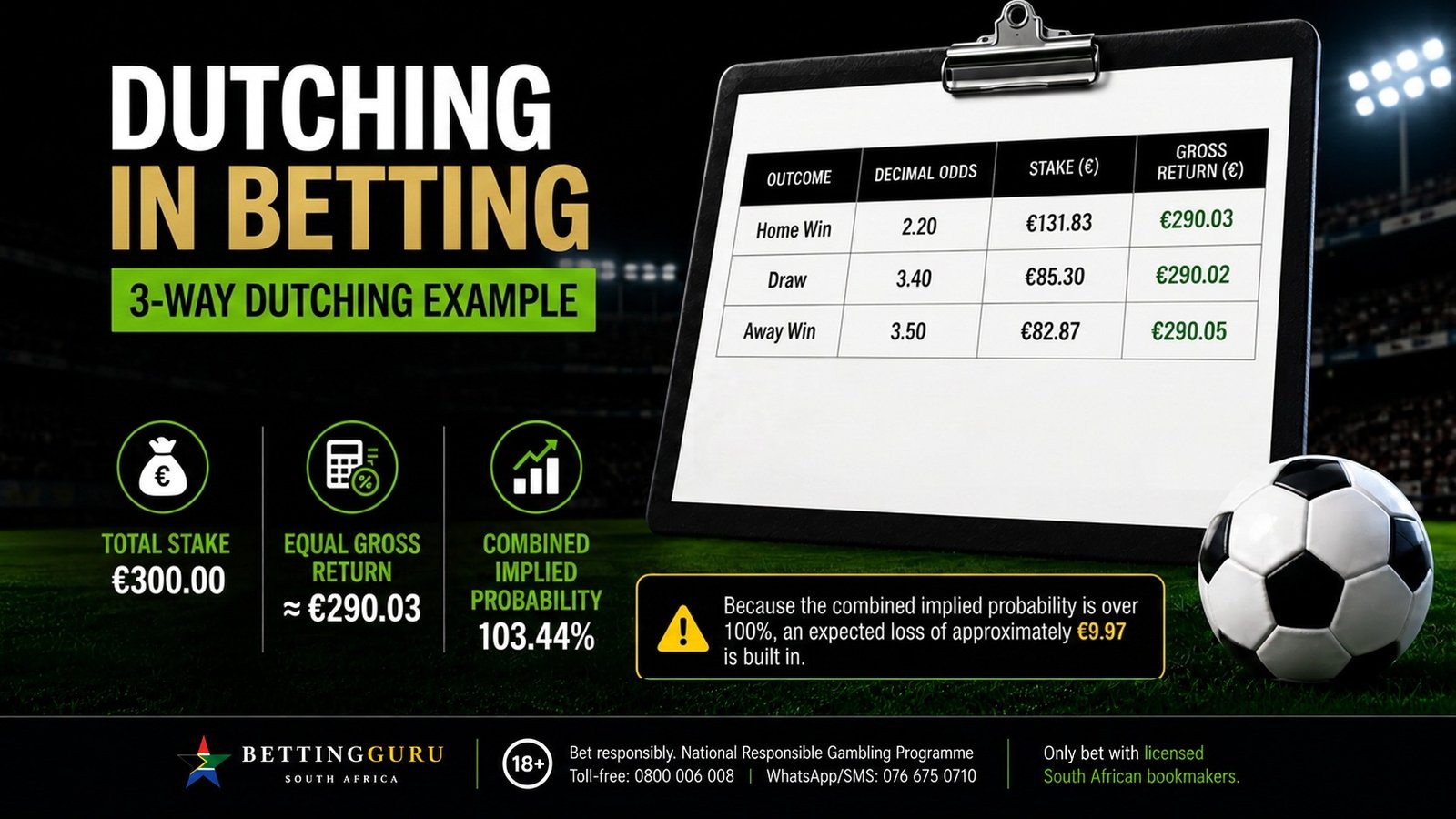
Three-Way Dutching Example
Now consider a football 1X2 market:
- Home win at 2.20
- Draw at 3.40
- Away win at 3.50
- Total stake of R300
| Selection | Odds | Dutching stake | Approximate return |
|---|---|---|---|
| Home win | 2.20 | R131.83 | R290.03 |
| Draw | 3.40 | R85.30 | R290.02 |
| Away win | 3.50 | R82.87 | R290.05 |
The combined implied probability is approximately 103.44%. Every possible match result is covered, but the equal result is still a loss of about R9.97 because of the margin built into the prices.
When Can Dutching Show a Positive Margin?
A positive equal-return result can appear when the sum of the selected implied probabilities is below 100%. This may occur when comparing prices across operators, although odds can move quickly and stake limits or market differences can prevent the result from being achieved.
Suppose three exhaustive outcomes are priced at 2.60, 3.10 and 4.20. Their combined implied probability is about 94.53%. Dutching R500 would produce an equal gross return of approximately R528.94 and a theoretical margin of R28.94 before rounding.
That calculation only represents a complete cover if the selections truly account for every possible winning outcome under matching settlement rules. A void bet, different overtime treatment, changed price or rejected stake can change the result.
Dutching is not a betting system that beats probability
It does not make the selected outcomes more likely to win. If an unselected result occurs, the full total stake can be lost. Even when all outcomes are covered, normal bookmaker margins often produce a small equal loss.
Common Dutching Mistakes
Leaving an outcome uncovered
Backing the home and away teams in a football 1X2 market does not cover a draw.
Mixing settlement rules
“Match winner” and “to qualify” may treat extra time and penalties differently.
Ignoring odds movement
One price can change between bets, altering the intended return and total margin.
Using equal stakes
Equal stakes do not produce equal returns when the decimal odds are different.
Confusing return with profit
The return includes the stake. Subtract all stakes to calculate the net result.
Overlooking limits and voids
Maximum stakes, account restrictions and voided selections can disrupt the calculation.
How to Use the BettingGuru Dutching Calculator
- Enter the total amount you intend to divide.
- Add each selection and its current decimal odds.
- Confirm that the selected outcomes are mutually exclusive.
- Check whether every possible winner is covered.
- Calculate the stakes and compare the equal gross return with the total stake.
- Recheck the odds immediately before placing any bets.
Frequently Asked Questions About Dutching in Betting
Is Dutching the same as arbitrage betting?
No. Dutching describes the way a stake is divided to equalise returns. Arbitrage requires prices that create a positive margin while covering every possible outcome.
Can Dutching be used for accumulators?
It can be applied to mutually exclusive accumulator outcomes, but the number of combinations and settlement risks can become complicated. The calculator is intended for straightforward decimal-odds selections.
How many selections can I enter?
The BettingGuru calculator supports between two and eight selections.
Does Dutching reduce risk?
It can spread exposure across selected outcomes, but it does not remove the risk of an uncovered result, losing margin, odds movement or settlement differences.
Is online sports betting legal in South Africa?
Sports betting is offered through operators licensed by South African provincial gambling authorities. Check the operator’s licence and the National Gambling Board’s information before depositing.
Use licensed operators and verify the market
Compare independently reviewed operators on our best sports betting sites in South Africa page. You can also consult the National Gambling Board’s verified-operator resource.
Important Disclaimer
BettingGuru SA calculators are provided for educational and informational purposes only. Results are mathematical estimates based on the values entered and do not guarantee winnings, profit, successful withdrawals or future betting outcomes.
Always check the latest operator terms, odds, bonus rules, wagering requirements, settlement rules and withdrawal conditions before depositing or placing a bet.
If gambling stops being fun or you feel you may be losing control, free and confidential support is available from the South African Responsible Gambling Foundation. Call 0800 006 008 or visit its website for help and support.
18+ only. Please gamble responsibly.