Blackjack Rules Explained: 9 Variations That Change the Odds
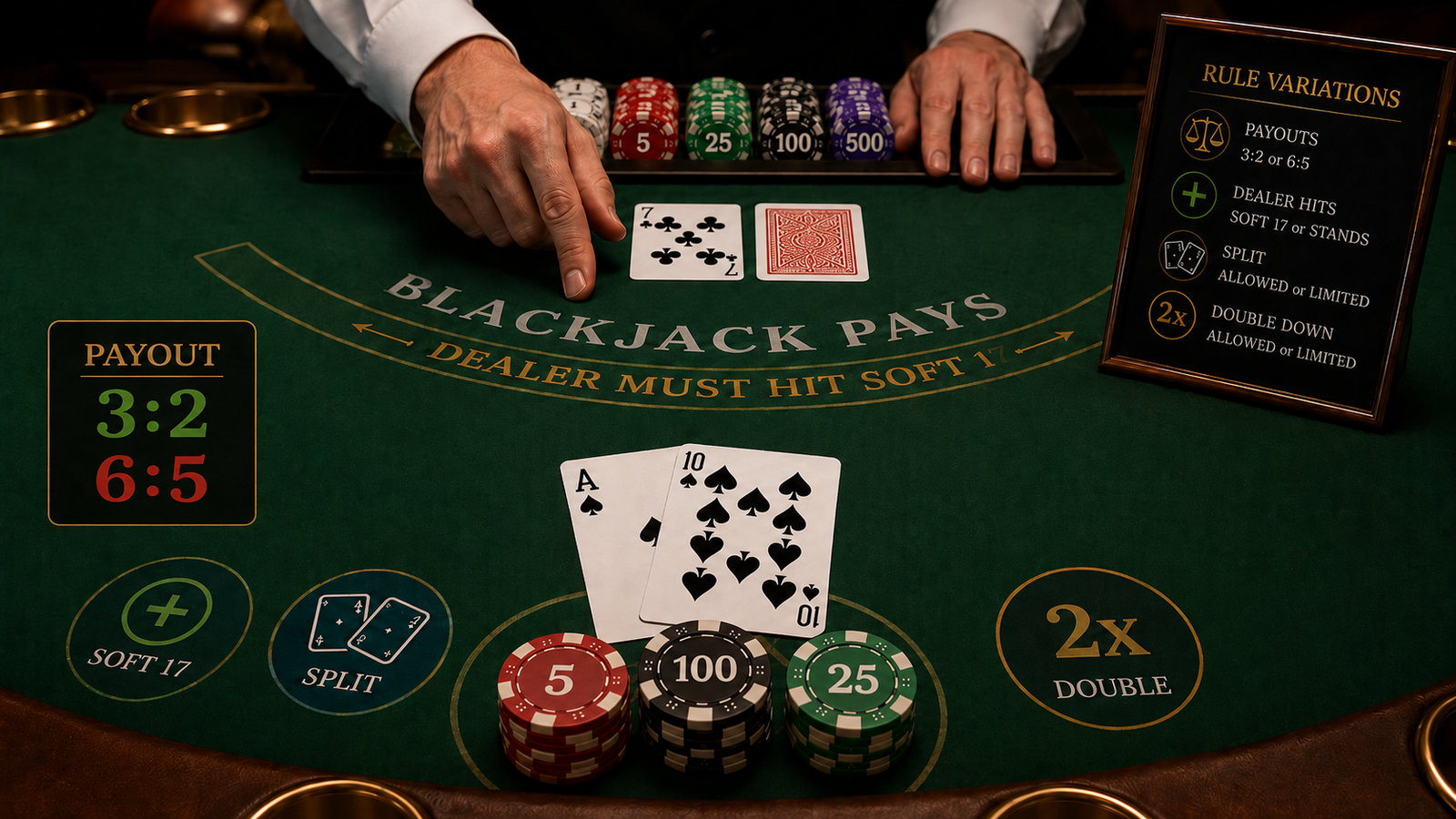
Blackjack rule variations can change the payout, house edge and correct strategy even when two tables look almost identical. The goal is still to beat the dealer without going over 21, but details such as 3:2 versus 6:5 payouts, soft 17, splitting and surrender determine the actual value of the game.
Understanding blackjack rule variations helps you compare tables before the first hand instead of relying only on the minimum bet or game title. A player who knows basic strategy but chooses an unfavourable rule set can give away more value than expected. For the decision-making side of the game, read our Blackjack Strategy Guide. This guide focuses on the rules that change what you are actually playing.
Article contents
- Blackjack Rule Variations Worth Checking First
- 1. Blackjack Pays 3:2 vs 6:5
- 2. Dealer Stands or Hits on Soft 17
- 3. Double Down Rules
- 4. Splitting and Resplitting
- 5. Surrender
- 6. Hole Card, Peek and European No-Hole-Card Rules
- 7. Number of Decks and Shuffling
- 8. Insurance, Perfect Pairs and 21+3
- 9. Unusual Push and Dealer Rules
- Popular Online Blackjack Rule Variations
- How to Compare Blackjack Rule Variations
- Blackjack Rules and Responsible Play
- Frequently Asked Questions
Blackjack Rule Variations Worth Checking First
These blackjack rule variations are the fastest way to judge a table. The payout normally matters most, but several smaller restrictions can combine to make an otherwise familiar game less favourable.
| Rule | Better for the player | Warning sign |
|---|---|---|
| Blackjack payout | 3:2 | 6:5 or even money |
| Dealer soft 17 | Dealer stands on soft 17 (S17) | Dealer hits soft 17 (H17) |
| Doubling | Double on any first two cards | Double restricted to selected totals |
| After splitting | Double after split allowed | No doubling after split |
| Surrender | Late surrender available | No surrender option |
| Split rules | Resplitting allowed; aces may be resplit | Only one split or restricted aces |
| Dealer blackjack | Dealer blackjack is checked before the player doubles or splits | No-hole-card rules may expose doubles and splits |
| Ties | Push: original bet returned | Player loses certain tied hands, or dealer 22 pushes otherwise-winning player hands |
1. Blackjack Pays 3:2 vs 6:5
Among all blackjack rule variations, the natural-blackjack payout is the first detail to check because it is easy to spot and has a large effect. At a 3:2 table, a R100 natural blackjack produces R150 profit, with the R100 stake returned separately. At 6:5, the same hand produces only R120 profit.
The difference may look small on one hand, but naturals occur often enough for the lower payout to matter. The Wizard of Odds blackjack rule-variation analysis estimates that changing a normal 3:2 payout to 6:5 adds about 1.39 percentage points to the house edge under otherwise identical conditions.
2. Dealer Stands or Hits on Soft 17
A soft 17 contains an ace counted as 11, such as Ace-6. At an S17 table, the dealer must stand. At an H17 table, the dealer takes another card. H17 is slightly less favourable to the player because the dealer has another chance to improve a weak total.
The rule is normally shown in the game information or printed on the table. It also changes a small number of basic-strategy decisions, so a strategy chart should match the exact table rules rather than simply say “blackjack”.
3. Double Down Rules
Doubling down lets you increase the original wager and receive one final card. The most flexible tables allow a double on any first two cards. Others restrict doubling to totals such as 9, 10 or 11.
A separate rule is double after split, usually shortened to DAS. When DAS is allowed, a newly split hand can still be doubled in suitable situations. Removing that option reduces the value of splitting certain pairs, particularly smaller pairs against weak dealer cards.
4. Splitting and Resplitting
Most blackjack games allow a pair to be split into two hands, but the details vary. A table may allow only one split, several resplits or special restrictions on aces. Common ace rules include one card only after splitting, no further action and no 3:2 payout when a ten-value card is dealt to a split ace.
Do not assume that “split available” means every normal split rule applies. Check the help screen for maximum hands, resplitting of aces and whether blackjack after a split is treated as a natural or an ordinary 21.
5. Surrender
Surrender allows the player to abandon a weak hand and recover half of the original stake. The common online form is late surrender. It is normally offered only after dealer blackjack has been ruled out. In no-hole-card games, the timing and treatment of surrender can vary by version.
Surrender is not used often, but it is useful in selected high-risk situations. Its presence is a positive table rule; it should not be confused with cashing out a bet or forfeiting a bonus.
6. Hole Card, Peek and European No-Hole-Card Rules
In many blackjack games, the dealer receives a hidden second card at the start and checks for blackjack when showing an ace or ten-value card. In a European no-hole-card game, the dealer receives the second card after players have completed their actions.
The important question is what happens to additional split or double-down wagers if the dealer later reveals blackjack. Some versions return those additional bets and take only the original stake; others take every wager. This rule can alter strategy and should be stated clearly in the game help.
7. Number of Decks and Shuffling
Blackjack can use one deck, two decks or a multi-deck shoe. Fewer decks can be slightly better when all other rules are equal, but casinos often combine single-deck games with less favourable rules such as 6:5 payouts or restricted doubling.
Online RNG blackjack may reshuffle after each round, while live tables can use a shoe, an automatic shuffler or a continuous shuffling machine. The number of decks matters less than the complete rule package. A well-run six- or eight-deck 3:2 game can be better than a single-deck 6:5 table.
8. Insurance, Perfect Pairs and 21+3
Insurance is offered when the dealer shows an ace. It is a separate wager on the dealer having blackjack and normally pays 2:1 when successful. Perfect Pairs, 21+3, Hot 3 and Bust It are also separate side bets based on specific card combinations or dealer outcomes.
These blackjack rule variations are separate from the main hand and use their own paytables. They can be entertaining, but the payouts do not reveal the underlying probability. Check the published RTP or house edge for each side bet rather than assuming a large headline payout represents strong value. Our RTP guide explains how long-term return differs from a short-term win.
9. Unusual Push and Dealer Rules
Some modern blackjack-style games alter familiar outcomes. Examples include a dealer total of 22 pushing player hands that would normally win, special Charlie rules that pay or win after a set number of cards, multipliers attached to selected totals, or a fee charged to fund enhanced payouts.
These blackjack rule variations are not automatically bad, but they cannot be judged using the assumptions of standard blackjack. Read the complete rules, fees and paytable before applying a normal strategy chart.
Popular Online Blackjack Rule Variations
| Variant | How it differs | What to check |
|---|---|---|
| Classic live blackjack | A real dealer runs a fixed number of seats at a streamed table. | Payout, soft 17, limits, side bets and split rules. |
| Infinite Blackjack | Unlimited players can join the same round, each receiving an individual hand after a shared starting hand. | Six Card Charlie, side bets, decision timing and minimum stake. |
| Lightning Blackjack | A scalable live-blackjack variant with a 100% Lightning fee. A winning score receives a 2x-25x multiplier that is saved for the next round. | Lightning fee, when the multiplier applies, standard payouts and published RTP. |
| First Person blackjack | An RNG game presented with a 3D table rather than a live dealer. | Rules, reshuffling, game speed and whether a live-table link is available. |
| Multi-hand blackjack | The player controls several hands in one round. | Total exposure, hand limits and whether each hand uses the same rule set. |
Online blackjack rule variations can change the number of seats, decision timing, side features and cost of each round. Evolution describes Infinite Blackjack as a scalable live game with unlimited seats. Lightning Blackjack combines scalable live blackjack with RNG-based multipliers: the player pays a 100% Lightning fee on every initial bet, and a winning score receives a 2x-25x multiplier for use in the next round. Evolution’s First Person range uses RNG outcomes and 3D presentation rather than a live dealer. These examples show why the game title alone is not enough to identify the rules.
How to Compare Blackjack Rule Variations
- Start with the natural-blackjack payout. Prefer 3:2 over 6:5.
- Check whether the dealer stands on soft 17.
- Confirm doubling and double-after-split rules.
- Review the split and resplit restrictions, especially for aces.
- Check whether surrender is available.
- Read what happens to extra wagers if the dealer has blackjack.
- Treat every side bet as a separate game with its own maths.
- Open the paytable and RTP information for the exact version you are playing.
- Use a strategy chart designed for the same rule set.
Compare blackjack rule variations as a complete package rather than judging one feature in isolation. When comparing operators, our South African casino reviews assess product quality, game information, mobile performance, licensing and responsible-gambling controls rather than looking only at the number of titles.
Reviewing blackjack rule variations before choosing a table takes less than a minute and can prevent avoidable mistakes throughout the session.
Blackjack Rules and Responsible Play
Favourable blackjack rule variations reduce the mathematical disadvantage; they do not turn blackjack into a guaranteed-profit game. Basic strategy cannot prevent losing sessions, and side bets or multiple simultaneous hands can increase the amount wagered quickly.
Set a session budget before opening a table, avoid increasing stakes to recover losses and take a break when decisions become rushed. Read our responsible gambling guide. Free and confidential support is also available from the South African Responsible Gambling Foundation on 0800 006 008.
Frequently Asked Questions
Which blackjack rule variations matter most?
Start with the 3:2 or 6:5 blackjack payout. Then check soft 17, doubling after a split, surrender, resplitting, no-hole-card exposure and any rule that changes ties or dealer blackjack.
Is 3:2 blackjack better than 6:5?
Yes. A natural blackjack pays more at 3:2. On a R100 stake, 3:2 produces R150 profit, while 6:5 produces R120 profit. The lower payout materially increases the house edge.
What does dealer hits soft 17 mean?
It means the dealer must draw another card on a total such as Ace-6. A stand-on-soft-17 table is generally slightly more favourable to the player.
What is double after split?
It allows a player to double a newly created hand after splitting a pair. Removing this option reduces the value of certain split decisions.
Is Infinite Blackjack the same as standard blackjack?
The core aim is similar, but Infinite Blackjack is designed for unlimited players and may include additional features such as Six Card Charlie and side bets. Check the specific rules before playing.
Are blackjack side bets part of basic strategy?
No. Side bets such as Perfect Pairs and 21+3 use separate paytables and probabilities. A normal blackjack strategy chart does not evaluate them.
Does a single-deck game always offer better odds?
No. Fewer decks can help when all other rules are equal, but single-deck tables often compensate with worse payouts or tighter doubling and splitting rules.
Sources and useful links
Disclaimer
This article is for informational and educational purposes only. It does not guarantee winnings and should not be treated as legal, financial or betting advice. Casino rules, game availability, RTP figures and promotional terms can differ between operators and versions. Always check the rules displayed inside the specific game before wagering. Gambling is for adults aged 18 and over only. Please gamble responsibly.