
How Bookmakers Calculate Cash Out (And Why You Lose Value)
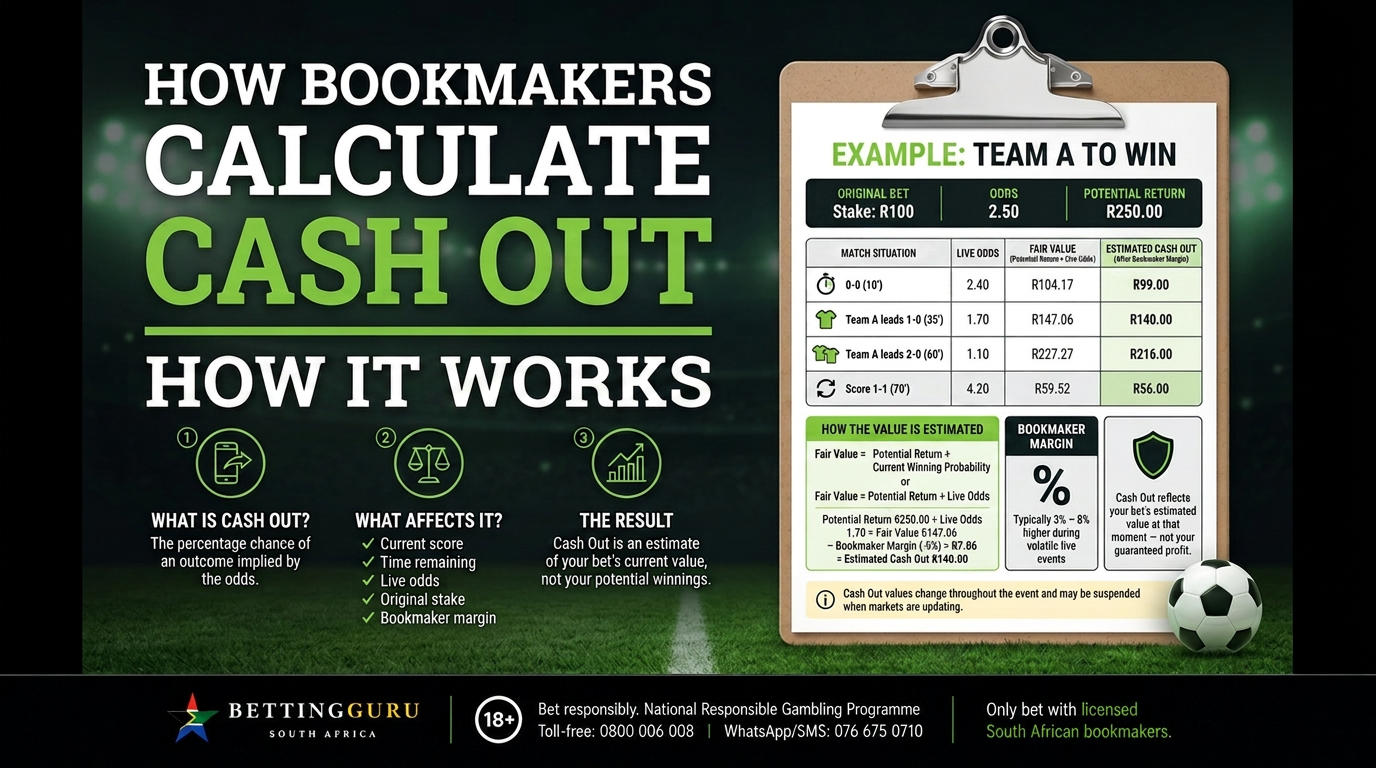
How bookmakers calculate cash out is not based on one universal public formula. An offer is generally derived from the bet’s potential payout and the current price of the remaining outcome, then adjusted for the bookmaker’s margin, risk controls and feature rules.
The displayed amount can change from second to second or disappear completely when a market is suspended. Cash out is an optional early-settlement offer, not a guaranteed right attached to every bet.
Article contents
What Is Cash Out?
Cash out allows a bettor to accept an early settlement before the normal result of the wager is known. The offer may be above or below the original stake:
- If the selection has become more likely, the offer may show a profit.
- If the selection has become less likely, the offer may return only part of the stake.
- If the market is suspended or unsupported, no offer may appear.
Once accepted, the cash-out amount normally replaces the eventual result for the settled portion. If the original bet later wins, no additional payout is due on the part already cashed out.
What Affects a Cash-Out Offer?
Potential payout
The maximum return if the original bet wins.
Current odds
The live price of the unresolved selection or remaining accumulator legs.
Bookmaker margin
An adjustment can reduce the amount below a simple fair-value estimate.
Event status
Score, time, cards, injuries, wickets and other events change the current probability.
Market availability
The operator needs a current tradable price to support the feature.
Rules and risk
Limits, errors, liabilities and technical suspensions can affect or remove the offer.
Simplified Cash-Out Formula
A useful educational estimate is:
This is equivalent to the amount that would produce the same potential return if placed at the current odds.
Worked Example: Single Bet
Assume:
- Original stake: R100
- Original odds: 3.00
- Potential payout: R300
- Current odds after the match develops: 1.50
A displayed offer might be R190 rather than R200 after pricing adjustments. The exact difference is operator-specific.
| Current odds | Approximate fair value | What changed | Likely direction |
|---|---|---|---|
| 1.50 | R200 | Selection became more likely | Offer above original stake |
| 3.00 | R100 | Probability broadly unchanged | Offer near stake before margin |
| 6.00 | R50 | Selection became less likely | Offer below original stake |
Worked Example: Accumulator Cash Out
Assume a R100 accumulator has a potential payout of R1,000. All completed legs have won and one selection remains.
Remaining Leg Currently Priced at 2.00
Remaining Leg Drifts to 4.00
The potential payout remains R1,000, but the early-settlement value falls because the final selection is now less likely according to the market.
More Than One Leg Remains
The operator estimates the joint current probability of all unresolved legs. If they are independent, multiplying current decimal prices gives a rough combined price. Correlated or same-event legs require a model adjustment.
Why Is the Cash-Out Offer Lower Than the Fair-Value Estimate?
- The current trading price may contain bookmaker margin.
- The cash-out feature can include an additional adjustment.
- The operator may use different internal prices from the public market.
- Limits and liability management can affect the offer.
- Fast-moving events create timing and suspension risk.
- A promotional or boosted original price may be treated differently.
The difference between the theoretical estimate and displayed amount is one reason repeatedly cashing out can reduce long-run returns.
Early, Partial and Auto Cash Out
Full Cash Out
Settles the entire eligible bet for the displayed amount.
Partial Cash Out
Settles part of the bet and leaves the remaining portion active. The available percentage and recalculated potential payout depend on the operator.
Auto Cash Out
Allows a target amount to be set. The operator attempts to cash out automatically if that amount becomes available, but execution may not be guaranteed in a rapidly moving market.
Betway South Africa currently advertises early, partial and auto cash-out features, subject to eligibility and availability.
Why Does Cash Out Become Unavailable?
- A goal, red card, penalty, wicket or other major event is being confirmed.
- The market is suspended or no current price is available.
- The bet type is not eligible.
- One leg uses a market excluded from cash out.
- The event data feed is delayed.
- The operator has reached a risk or liability threshold.
- The bet contains a builder or promotion excluded by the rules.
Official operator help pages commonly note that availability can be suspended during events such as VAR reviews.
Cash Out vs Placing a Hedge Bet
| Feature | Cash out | Hedge bet | Main consideration |
|---|---|---|---|
| Method | Accept one early-settlement offer | Place a new wager on another outcome | Hedging requires calculating stakes |
| Availability | Controlled by original bookmaker | Depends on available opposing markets | Neither is guaranteed |
| Pricing | One displayed offer | Can compare prices across operators | Separate accounts and limits may apply |
| Complexity | Simple to execute | Can create partial or uneven coverage | Settlement rules must match |
Should You Accept a Cash-Out Offer?
The decision depends on the current offer, the remaining probability, your reason for placing the bet and your financial limits.
Questions to Ask
- What is the potential payout?
- What are the current odds of the unresolved outcome?
- How does the displayed offer compare with a simple fair-value estimate?
- Has important information changed since the original bet?
- Would you place the remaining bet at the current odds today?
- Are you cashing out because of a planned rule or because of fear after watching the event?
- Would losing the remaining amount cause financial stress?
Cash out can reduce risk, but it is not automatically good or bad. Evaluate the price rather than the label.
Frequently Asked Questions About Cash Out
How do bookmakers calculate cash out?
They generally use the potential payout, current probability or odds, unresolved legs, margin and risk rules. The exact algorithm is proprietary.
What is a simple cash-out formula?
Potential payout divided by current decimal odds gives a rough fair-value estimate before operator adjustments.
Why is my cash-out amount below the stake?
The market now considers the bet less likely to win, or the offer contains pricing adjustments.
Why did cash out disappear?
The market may be suspended, a key incident may be under review or the bet may no longer be eligible.
Can cash out be cancelled after acceptance?
Accepted cash outs are normally final, but operator terms may allow correction or resettlement when an amount resulted from a pricing or settlement error.
Is cash out always worse than letting the bet run?
No. It reduces uncertainty at a price. Whether the offer is attractive depends on the current probability and amount offered.
South African Betting and Licensing
Online betting is legal when it is offered by a bookmaker licensed in South Africa and used by a person aged 18 or older. Verify an operator through the relevant provincial licensing authority or the National Gambling Board’s verified-operator portal.
Responsible Betting
Cash-out calculations can help explain how betting prices and features work, but it cannot make an uncertain outcome guaranteed. Set a fixed budget, use stakes you can afford to lose and never chase losses.
Free and confidential support is available through the South African Responsible Gambling Foundation. Call 0800 006 008 or WhatsApp/SMS HELP to 076 675 0710.
Gambling is for adults aged 18 and over only. Please gamble responsibly.
Sources and Useful Links
- BettingGuru SA – How to Read Sports Betting Odds
- BettingGuru SA – Implied Probability Explained
- BettingGuru SA – Bookmaker Margin Explained
- BettingGuru SA – Bet Builder Explained
- BettingGuru SA – Bankroll Management
- National Gambling Board – Verified Operators
- National Gambling Board – Gambling FAQs
- South African Responsible Gambling Foundation
- Betway South Africa – Cash Out
- bet365 Help – VAR and Cash Out Availability
- bet365 Help – House Rules
BettingGuru SA Disclaimer
BettingGuru SA is an independent betting information and comparison platform. This article is provided for educational purposes and does not guarantee winnings or constitute legal, financial or professional advice. Odds, markets, calculations, features and operator rules can change. Check the current bookmaker terms before placing a bet. 18+ only. Please gamble responsibly.