FIFA vs UEFA: The Real Difference Explained
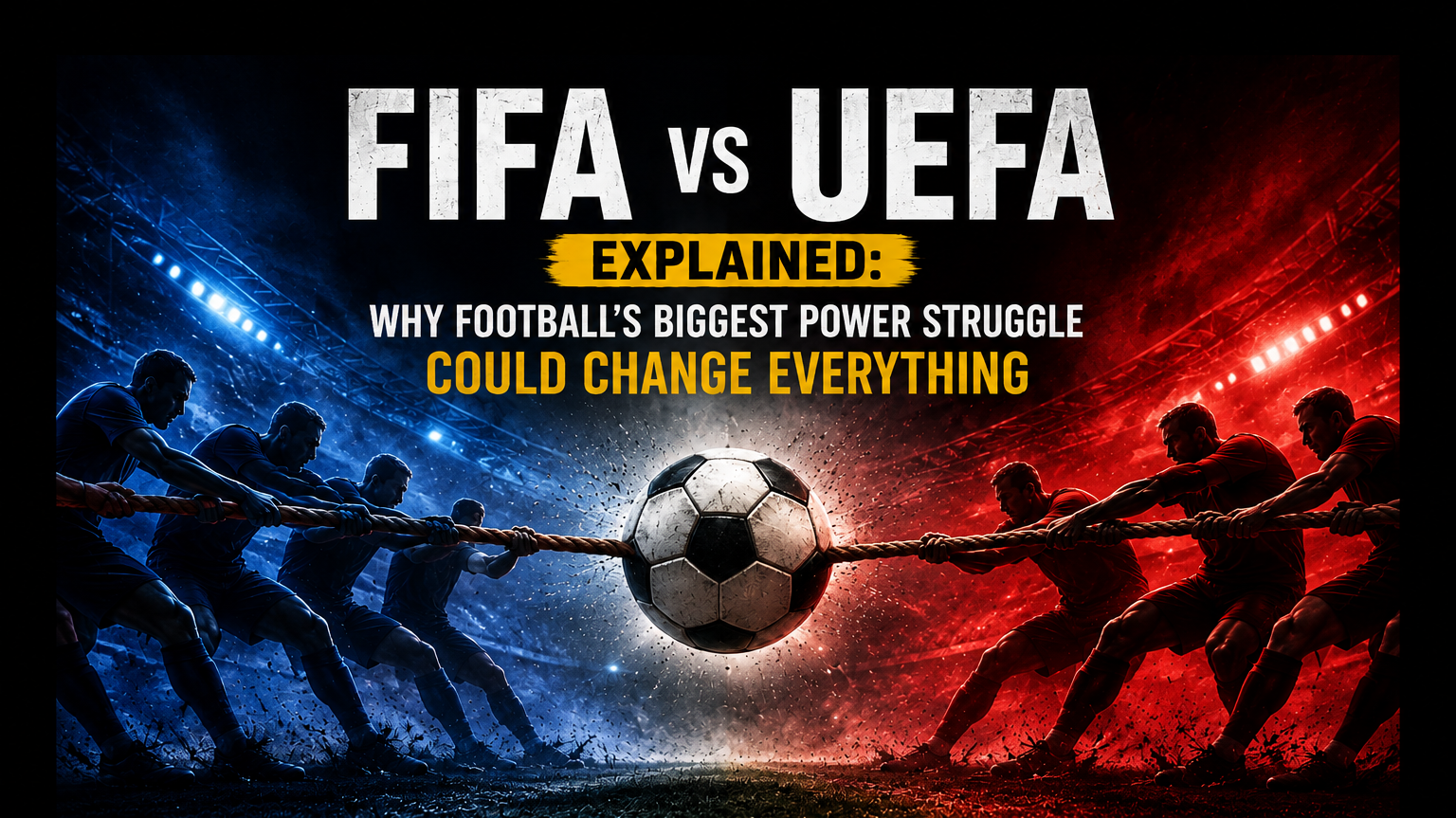
For most of the last decade, the FIFA vs UEFA rivalry has been a boardroom sport played behind closed doors. In the summer of 2026, it spilled out into the open. European football’s 55 national associations voted to boycott FIFA competitions, FIFA’s own chief operating officer accused the leadership of deceiving staff, and within 48 hours a $20 billion plan to sell a slice of the World Cup was dead.
If you follow football only through fixtures and odds, this can look like distant politics. It is not. The outcome decides how many World Cup teams there are, how crowded the calendar gets, which tournaments get created next, and ultimately which markets appear on your betting slip. Here is the plain-English version of who runs what, why the two bodies collided, and what happens next.
Article contents
FIFA vs UEFA: The Basic Difference
The simplest way to understand the relationship is as a pyramid. FIFA sits at the top of world football. UEFA is one of six continental confederations that sit beneath it and is financially and sportingly, by far the most powerful one.
What FIFA Is
- Founded in 1904, headquartered in Zurich, Switzerland
- A not-for-profit association under Swiss law with 211 member national associations
- Owns and organises the men’s and women’s World Cups, the Club World Cup, youth World Cups and the international match calendar
- Writes the global rulebook: transfer regulations, agent rules, eligibility, and the release of players for national teams
- Its president is elected by the 211 members at the FIFA Congress. One nation, one vote, whether that nation is Brazil or Montserrat
What UEFA Is
- Founded in 1954, headquartered in Nyon, Switzerland
- The governing body for Europe, with 55 member associations
- Owns the UEFA Champions League, Europa League, Conference League, the men’s and women’s EURO and the Nations League
- Answers to FIFA on global matters, but controls its own competitions, its own commercial rights and its own money
That last point is the heart of the conflict. UEFA is technically subordinate to FIFA, but it generates a comparable amount of money, controls the world’s richest club competition, and supplies most of the players and nearly all of the recent winners of FIFA’s flagship event. Europe has won every men’s World Cup final it has contested since 2006 except one, and European clubs employ the overwhelming majority of the players who appear at the tournament.
Why the Two Bodies Keep Colliding
Four structural tensions explain almost every FIFA vs UEFA argument of the last ten years.
1. One Nation, One Vote
At the FIFA Congress, Europe’s 55 votes are outnumbered by Africa (54), Asia (46), CONCACAF (35), CONMEBOL (10) and Oceania (11). A FIFA president can therefore be elected and re-elected without European support and can pass policy that Europe hates. Europe’s leverage is not votes, it is the product: the players, the clubs, the broadcasters and the sponsors.
2. The Calendar Is Full
Every new FIFA competition takes dates from somewhere. The 2025 Club World Cup expansion, proposals for a biennial World Cup, and a possible 64-team 2030 tournament all eat into the windows UEFA uses for the Champions League and domestic leagues. Player unions and leagues have backed UEFA on this, arguing elite players are already at their physical limit.
3. Money Flows in Different Directions
FIFA’s model spreads World Cup income thinly across 211 members through development grants. UEFA’s model concentrates income on European clubs and associations, with a solidarity layer beneath. Every FIFA expansion is, in effect, a transfer of value away from the European club game.
4. Governance and Trust
FIFA has never fully shed the reputational damage of the 2015 corruption crisis. When it announces a major structural change without consultation, European associations treat it as a governance failure first and a commercial idea second.
The 2026 Flashpoint: Selling a Stake in the World Cup
In July 2026, days after the expanded 48-team World Cup ended with Spain beating Argentina in the final at MetLife Stadium, FIFA president Gianni Infantino confirmed a plan to create a commercial subsidiary called FIFA Forward Enterprise. Outside investors, led by the American venture capital firm Thrive Eternal, would buy a minority stake of roughly 20% in the entity holding FIFA’s commercial rights, at a valuation of about $20 billion.
Every one of FIFA’s 211 members was offered $20 million to back it, with a deadline of 19 September. UEFA’s response was the most aggressive move European football has made against FIFA in modern history: on 30 July its member associations voted to boycott all FIFA competitions if the plan went ahead. CONCACAF rejected it. The Asian Football Confederation declared solidarity with both.
The arithmetic was decisive. Approval needed 106 of 211 votes. UEFA’s 55, CONCACAF’s 35 and Asia’s 46 add up to 136 against. On 31 July, Infantino announced the proposal would not proceed, saying it had created divisions that were no longer in the interest of its original objective.
Who Actually Won?
In the short term, UEFA. It proved that a coordinated European veto can stop a FIFA presidential project even when the president has letters of support from roughly 200 member associations. That is a precedent, and precedents in football governance tend to get reused.
But UEFA’s victory carries a cost. It confirmed publicly that global football’s two power centres can be pushed to the brink of a formal split. The kind of scenario that, taken to its conclusion, produces breakaway competitions rather than a single World Cup. Both sides now have an interest in appearing reasonable.
The unresolved question is Infantino himself. Candidates for the next FIFA presidency have until 18 November 2026 to declare, with the vote at the FIFA Congress in Rabat, Morocco on 19 March 2027. Before this crisis, re-election looked uncontested.
What It Means for Football Fans and Bettors
Governance news changes betting markets more often than people assume, because it changes formats, fixture density and squad rotation. Four practical consequences to watch:
- Tournament format. A 64-team 2030 World Cup remains on the table and is backed by CONMEBOL. More teams means more mismatches, longer group stages and heavier favourite pricing in the early rounds.
- Fixture congestion. If FIFA adds events, elite European clubs rotate more. That undermines the reliability of season-long form models in the Champions League and domestic leagues.
- Broadcast and sponsorship money. Whoever controls the commercial rights controls how competitions are scheduled for television, which affects kick-off times, rest days and travel.
- Market availability. New competitions create new markets. The 2025 Club World Cup added a full set of outrights and match markets to South African books within a single cycle.
If you want to translate that into pricing, start with the fundamentals: how to read sports betting odds and implied probability explained. Both matter more in new or reformatted competitions, where bookmakers have less historical data and margins tend to be wider. A point we unpack in bookmaker margin explained.
FIFA vs UEFA: Quick Comparison
| Category | Detail |
|---|---|
| Scope | FIFA is global with 211 members; UEFA is European with 55 members |
| Flagship event | FIFA World Cup versus UEFA Champions League and the EURO |
| Revenue model | FIFA earns in four-year cycles peaked around the World Cup; UEFA earns annually from club competitions |
| Voting power | FIFA gives every nation one vote; UEFA’s power comes from commercial and sporting weight, not vote count |
| Recent revenue | FIFA reported a record 2023-26 cycle; UEFA passed 5 billion euros in a single non-EURO season for the first time in 2024/25 |
For the full financial picture, read our breakdowns of how FIFA makes money and how UEFA makes money.
FIFA vs UEFA is not a personality clash. It is a structural argument about who owns the commercial upside of the world’s most popular sport, and it has no permanent solution while one body holds the votes and the other holds the product. The 2026 investment plan was the first time the argument was settled in public, with a clear loser. It will not be the last.
Whatever happens next, bet with a plan rather than a headline. Our guides to bankroll management and responsible gambling are the right place to start.
Responsible Gambling
Betting should cost you no more than any other form of entertainment. Use deposit limits, take breaks, and contact the South African Responsible Gambling Foundation on 0800 006 008 or WhatsApp/SMS HELP to 076 675 0710 if it stops feeling like a choice.
Gambling is for adults aged 18 and over only. Please gamble responsibly.
Frequently Asked Questions
Is UEFA part of FIFA?
Yes. UEFA is one of six continental confederations affiliated to FIFA. It runs European football and its own competitions, but FIFA sets the global rules and owns the World Cup.
Can UEFA leave FIFA?
In theory, yes, in July 2026 its members voted to boycott FIFA competitions. In practice a full split would cost European nations World Cup participation, so it is used as leverage rather than a genuine plan.
FIFA vs UEFA — who is more powerful?
FIFA has the formal authority and the World Cup. UEFA has the players, the clubs and a comparable revenue base. The 2026 crisis showed that FIFA cannot pass a major structural change without European consent.
Does the FIFA vs UEFA conflict affect betting?
Indirectly but meaningfully. Competition formats, calendar density and squad rotation all shift with governance decisions, and those shifts feed straight into pricing and team selection.
Sources
BettingGuru SA Disclaimer
BettingGuru SA is an independent sports betting review and information platform. This article is for informational and entertainment purposes only and is not a guarantee, betting instruction or financial recommendation. BettingGuru may receive commission from selected partners, but this does not influence editorial analysis. Gambling is for adults aged 18 and over only. Please gamble responsibly.