How FIFA Makes Money: The Full Breakdown
FIFA is legally a not-for-profit association registered in Zurich. It is also one of the most profitable sports businesses on the planet. Across the 2023-26 cycle that ended with the expanded 48-team World Cup in North America, FIFA generated the largest revenue total in its history — a figure reported between roughly $13 billion and $15 billion depending on which line items are counted.
Here is how FIFA makes money and where it goes.
Article contents
FIFA Earns in Four-Year Cycles, Not Seasons
The single most important thing to understand about FIFA’s finances is the rhythm. Almost all of its income arrives in the year of a men’s World Cup. FIFA therefore budgets and reports in four-year cycles, running from the year after one World Cup to the year of the next.
| Cycle | Revenue |
|---|---|
| 2015-2018 (Russia) | ~$6.4 billion |
| 2019-2022 (Qatar) | ~$7.57 billion |
| 2023-2026 (USA, Canada, Mexico) | Budgeted $11bn, revised to ~$13bn, some reporting up to $15bn |
FIFA has estimated that around $8.9 billion of the current cycle comes directly from the 2026 World Cup alone. Much of the extra revenue above the original budget came from the new-format Club World Cup staged in 2025, which was not in the original plan.
The Four Revenue Streams
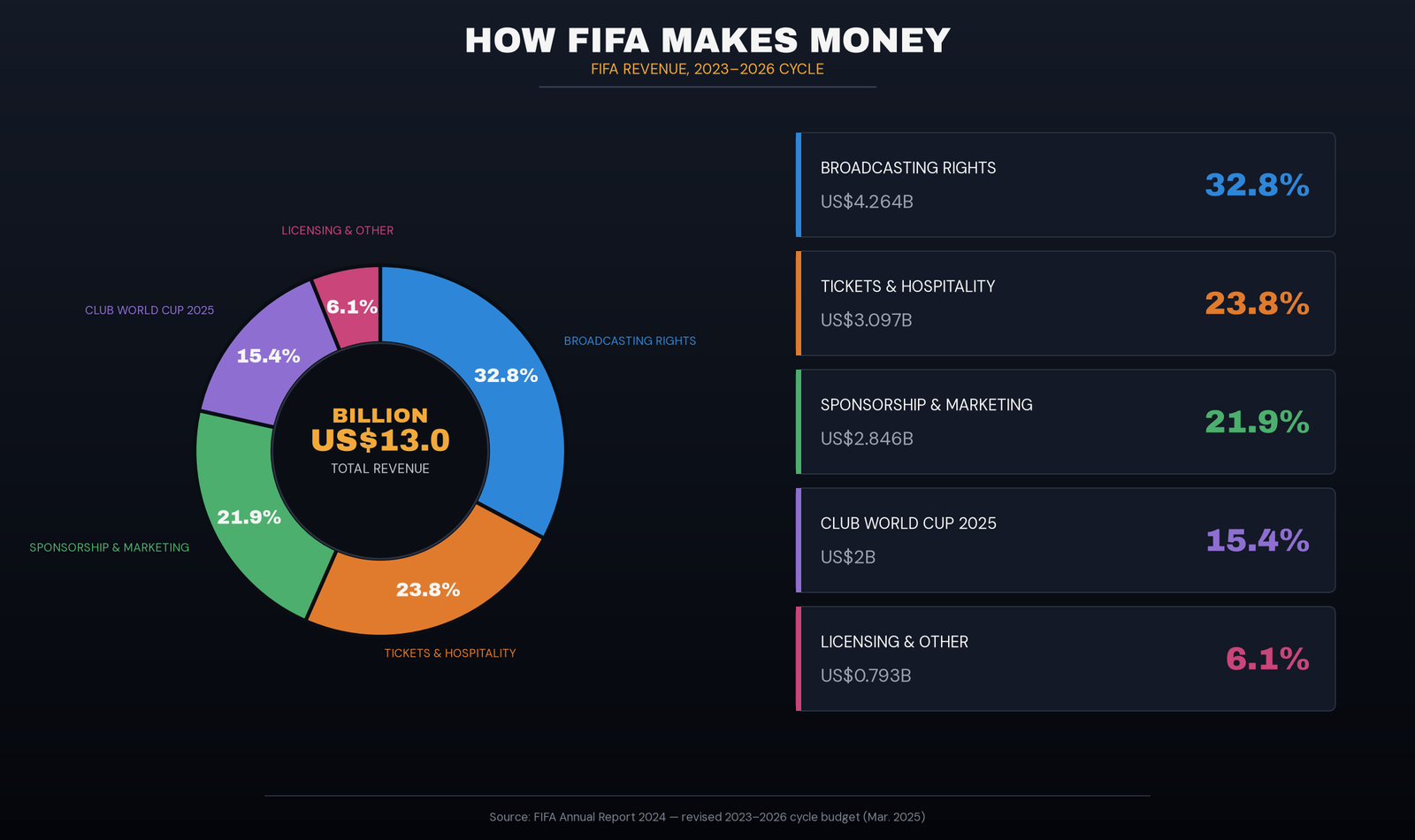
1. Television and Broadcasting Rights — ~32.8%
By far the biggest line. On FIFA’s revised $13.0 billion cycle budget, broadcasting accounts for $4.264 billion. The 2026 tournament pushed the underlying number higher: analysts at Ampere Analysis projected around $3.8 billion in broadcast revenue for the event itself, up roughly 22% on Qatar 2022. The standout market was the United States, where domestic rights values are estimated to have risen by about 94%.
Broadcast deals are usually sold territory by territory on multi-cycle contracts, which is why FIFA can forecast income years in advance.
2. Hospitality and Ticketing — ~23.8%
$3.097 billion on the revised cycle budget. This stream grew fastest and most controversially in 2026. For the first time at a World Cup, FIFA used dynamic pricing, letting prices move with demand. Group-stage tickets ranged from about $380 to $4,105, premium final tickets reached $13,000 to $16,000 at face value, and listings on FIFA’s own resale platform for the final at MetLife Stadium reportedly reached as high as $2 million.
3. Marketing and Sponsorship — ~21.9%
$2.846 billion on the revised cycle budget, with roughly $2.4 billion projected for the 2026 tournament alone. FIFA sells in tiers: FIFA Partners hold year-round rights across all FIFA events and reportedly pay upwards of $100 million a year; World Cup sponsors pay an estimated $65 million to $95 million for tournament rights; regional supporters pay around $15 million.
The commercial roster for 2026 tilts heavily American — 14 of FIFA’s 26 backers were headquartered in the United States, including Coca-Cola, Visa, Bank of America, McDonald’s and Verizon.
4. Club World Cup 2025 — ~15.4%
$2.0 billion. This is the single biggest reason the cycle budget grew from its original $11 billion to roughly $13 billion — the expanded, 32-team Club World Cup staged in the United States in June and July 2025 was not part of the original plan and effectively created a new revenue line worth about a seventh of FIFA’s total four-year income.
5. Licensing and Other Income — ~6.1%
$0.793 billion on the revised cycle budget. This covers video game and merchandise licensing, brand licensing and smaller commercial arrangements. It is the smallest stream but the highest-margin one.
Where FIFA’s Money Goes
FIFA’s own framing is that more than 90% of its budget is reinvested into football. On the published $11 billion budget the main outflows were:
- Competitions and events: about $5.62 billion, with the 2026 World Cup the largest single item at roughly $3.84 billion
- Development and education: about $3.92 billion, mostly FIFA Forward grants to the 211 member associations and six confederations
- Operations, governance and other costs: about $1.36 billion
- Budgeted surplus: roughly $100 million, added to reserves already sitting near $4 billion
Two outflows go directly to the people on the pitch. The 2026 prize pool was a record $871 million, with a guaranteed minimum of $12.5 million per qualified nation and around $53.5 million for the winners. Separately, a $355 million Club Benefits Programme compensated clubs for releasing players — up about 70% on Qatar, and for the first time including $100 million for clubs whose players featured in qualifying.
Why FIFA Wanted Outside Investors Anyway
With record revenue and $4 billion in reserves, FIFA’s July 2026 attempt to sell a 20% stake in a commercial subsidiary at a $20 billion valuation surprised many observers. The internal logic was that FIFA is under-monetised relative to the audience it commands, and that a permanent commercial vehicle would smooth the four-year revenue spike into something closer to an annual business.
European and North American associations disagreed, and the plan was scrapped within days. We covered that story in why FIFA cancelled its $20 billion World Cup investment plan and the governance context in FIFA vs UEFA explained.
How FIFA Compares to UEFA
FIFA’s income is bigger but lumpier. UEFA generates a steadier annual figure — it passed 5 billion euros in 2024/25, the first time it did so in a season without a men’s EURO. Over a full four-year cycle the two organisations are closer than most fans assume. See how UEFA makes money for the European side of the ledger.
What It Means If You Bet on International Football
If you bet on international football, the same discipline applies to money as to fixtures. Start with bankroll management, check the betting terms glossary if anything is unfamiliar, and keep our responsible gambling guidance close.
Responsible Gambling
Betting should cost you no more than any other form of entertainment. Use deposit limits, take breaks, and contact the South African Responsible Gambling Foundation on 0800 006 008 or WhatsApp/SMS HELP to 076 675 0710 if it stops feeling like a choice.
Gambling is for adults aged 18 and over only. Please gamble responsibly.
Frequently Asked Questions
Is FIFA a non-profit?
Yes. FIFA is a not-for-profit association under Swiss law. That does not stop it generating billions in revenue — it means surpluses are retained as reserves or reinvested rather than paid to shareholders.
How much did FIFA make from the 2026 World Cup?
FIFA has estimated roughly $8.9 billion of its 2023-26 cycle revenue comes directly from the 2026 tournament, making it the most lucrative sporting event ever staged.
What is FIFA’s biggest revenue source?
Television and broadcasting rights, at 32.8% of the revised $13.0 billion cycle revenue.
How much prize money did the 2026 World Cup pay?
A record $871 million, with about $53.5 million to the winners and a guaranteed $12.5 million minimum per qualified nation.
Sources
FIFA’s business is a broadcast business with a tournament attached. Every structural decision it makes — expanding to 48 teams, adding a Club World Cup, debating a 64-team 2030 — flows from the same logic: more matches means more inventory to sell. Understanding that makes the politics far easier to predict.
BettingGuru SA Disclaimer
BettingGuru SA is an independent sports betting review and information platform. This article is for informational and entertainment purposes only and is not a guarantee, betting instruction or financial recommendation. BettingGuru may receive commission from selected partners, but this does not influence editorial analysis. Gambling is for adults aged 18 and over only. Please gamble responsibly.