Why FIFA Cancelled Its $20 Billion World Cup Investment Plan
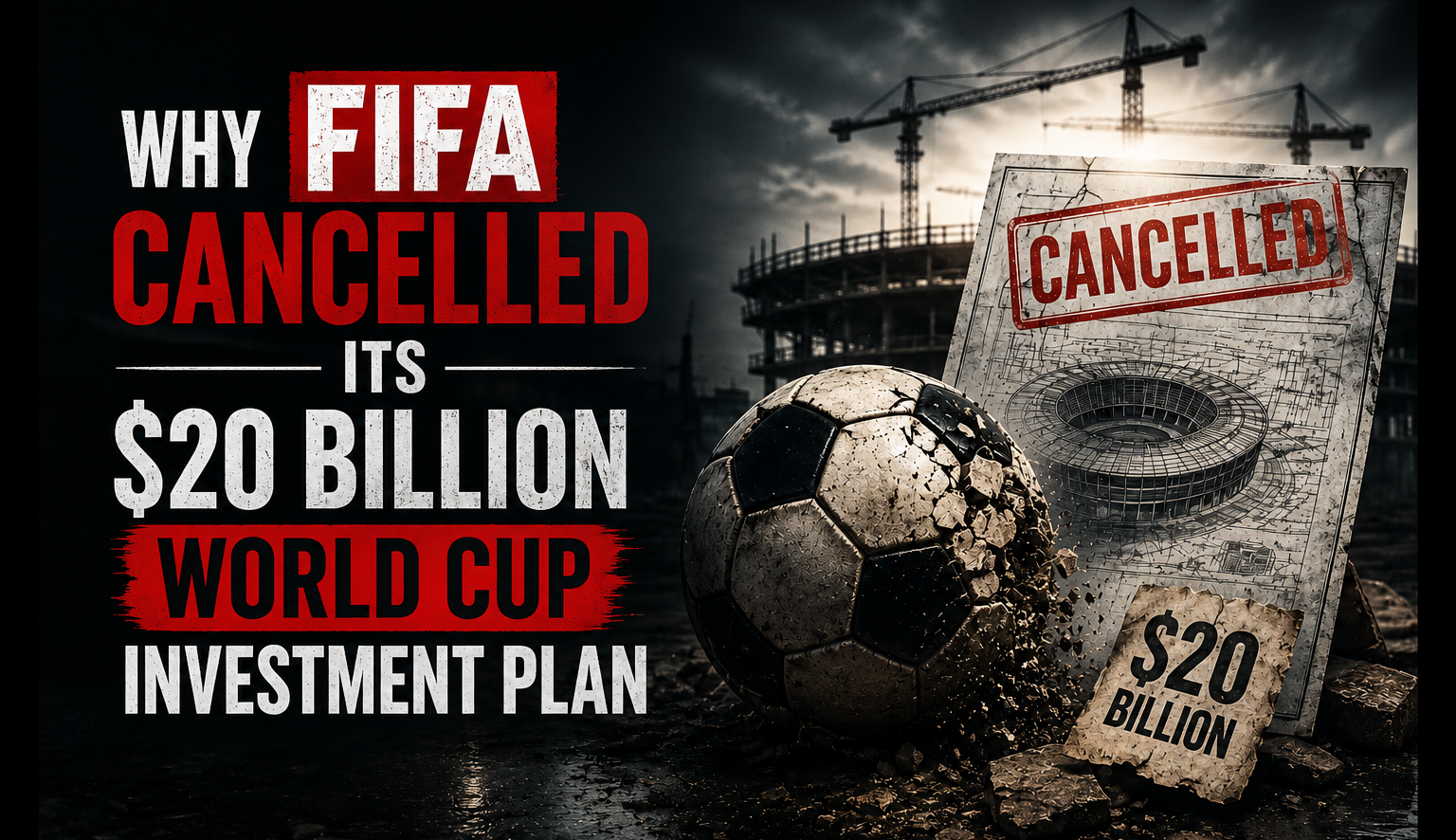
Twelve days after the 2026 World Cup final, FIFA president Gianni Infantino abandoned the most ambitious financial project of his presidency. The plan would have sold roughly a fifth of FIFA’s commercial business to private investors at a $20 billion valuation. It lasted barely a week in public before collapsing under opposition from three continents, two senior FIFA figures and a resigning adviser.
This is what the FIFA investment plan actually was, why it failed, and what it tells you about who really controls football.
Article contents
What Was the FIFA Investment Plan?
FIFA is a not-for-profit association under Swiss law, owned in effect by its 211 member national associations.
What Was FIFA Forward Enterprise (FFE)?
The centrepiece of FIFA’s investment plan was the creation of FIFA Forward Enterprise (FFE), a new commercial subsidiary that would have housed FIFA’s revenue-generating activities.
Rather than selling a stake in FIFA itself, the proposal would have transferred the organisation’s commercial assets — including World Cup broadcasting rights, sponsorships, ticketing, hospitality and tournament operations — into FFE. Private investors would then have been offered roughly a 20% stake in that commercial business.
| Detail | Figure |
|---|---|
| Valuation of the new entity | About $20 billion |
| Stake offered to investors | Roughly 20%, raising an estimated $4.2 billion |
| Anchor investor | Thrive Eternal (Joshua Kushner, brother of Jared Kushner) |
| Payment per member association | $20 million up front, rising to $22m per cycle to 2034, $24m to 2038 |
| Deadline to accept | 19 September 2026 |
The pitch rested on a single argument, set out in a 25-page document prepared by investment bank JP Morgan: the World Cup is the most widely watched sporting event on earth, and FIFA is under-monetised. According to FIFA, the investment plan would unlock the commercial value of the World Cup and provide greater financial support to member associations.
Members were already due about $10 million each over the 2027-2030 cycle. FFE would have doubled that. For federations in Andorra, Montserrat or Papua New Guinea, that is transformational money. For England, Spain or France, it is a rounding error against what they would lose if the club calendar were reshaped to service an investor return.
Why the FIFA Investment Plan Was Cancelled
The Maths Never Worked
Any structural change of this size needed a simple majority at the FIFA Congress: 106 of 211 votes. UEFA controls 55, CONCACAF 35 and the Asian Football Confederation 46. When all three declared against, the theoretical opposition was 136 votes — well beyond a blocking position.
UEFA Escalated to a Boycott Threat
On 30 July, UEFA’s member associations voted to boycott all FIFA competitions unless the plan was dropped. That is the nuclear option in football governance: European teams have won or contested nearly every recent men’s World Cup final, and European clubs supply most of the players. A World Cup without Europe is not a World Cup that any broadcaster would pay $4 billion for.
FIFA’s Own House Turned
Carlos Cordeiro, Infantino’s senior adviser on global strategy and governance and a former Goldman Sachs banker, resigned. He called it a bad deal for football that would mortgage the game’s future. FIFA chief operating officer Kevin Lamour said publicly that FIFA’s own administration had been deceived about the project. Former FIFA president Sepp Blatter added that FIFA belongs to no individual or institution.
The Politics Were Toxic
The anchor investor’s family connection to the US presidency turned a financial story into a political one, in a year when FIFA had already been criticised for the closeness of its relationship with Washington. Donald Trump said he had not been consulted on the plan. UK prime minister Andy Burnham said Infantino was the wrong man to lead FIFA.
Nobody Was Consulted
The most damaging criticism was procedural rather than financial. Associations, confederations, leagues and player bodies said they learned about a restructuring of the sport’s governing body from the media. Even bodies with no ideological objection to private capital objected to the process.
What Infantino Said
In his 31 July statement, Infantino said that after listening to all views it had become clear the project had created divisions that were no longer in the interest of the objective set out in the first place, and that the proposal would not proceed. He added that he intended to bring interested parties back together, and that FIFA’s purpose has always been to unite and improve.
What Happens Now
- Presidential race. Candidates must declare by 18 November 2026. The vote takes place at the FIFA Congress in Rabat, Morocco, in March 2027. Names raised in coverage include Nasser Al-Khelaifi and FIFA vice-president Victor Montagliani.
- The 64-team 2030 question. CONMEBOL, which had not opposed the plan, is pressing for a 64-team World Cup in 2030 to give more matches to co-hosts Argentina, Paraguay and Uruguay. That fight is unresolved.
- Governance reform. Expect proposals to require consultation before structural changes — the process failure, not the money, is what united the opposition.
- Commercial pressure remains. FIFA’s income is lumpy, peaking every four years. The underlying incentive to smooth and grow it has not gone away, so a redesigned version of this idea is likely to return in a different shape.
Why Bettors Should Care
A privately part-owned FIFA would have had a contractual incentive to add matches and competitions, because investor returns scale with inventory. More matches means more rotation at elite clubs, more fixture congestion and more unpredictable team news — all of which widen bookmaker margins and reduce the reliability of form-based models.
The plan’s collapse keeps the calendar roughly where it is for now. If you are pricing World Cup or Champions League markets, that stability matters. Our guides to value betting and sports betting markets explain how format changes feed into the numbers, and our Kelly Criterion calculator helps you size stakes when uncertainty is high.
Responsible Gambling
Betting should cost you no more than any other form of entertainment. Use deposit limits, take breaks, and contact the South African Responsible Gambling Foundation on 0800 006 008 or WhatsApp/SMS HELP to 076 675 0710 if it stops feeling like a choice.
Gambling is for adults aged 18 and over only. Please gamble responsibly.
Frequently Asked Questions
How much was FIFA’s investment plan worth?
The proposed subsidiary was valued at about $20 billion, with investors buying roughly 20% for an estimated $4.2 billion.
Why did FIFA cancel its investment plan?
FIFA said the proposal created divisions among member associations and no longer served its original purpose.
Who was going to invest in FIFA?
The reported anchor investor was Thrive Eternal, a vehicle launched by Joshua Kushner, leading a wider investor group.
Why did UEFA oppose the plan?
UEFA argued that private investors would demand more matches and bigger competitions, threatening the balance of the calendar and the revenues of European club football.
Is Infantino still FIFA president?
Yes. He remains in office, but the crisis has made his previously uncontested re-election bid in March 2027 far less certain.
Sources
The collapse of the FIFA investment plan revealed the limits of football’s governing structure. FIFA can win elections without Europe, but it cannot run a World Cup without it. For a full explainer of the two bodies and the structural conflict behind this episode, read FIFA vs UEFA explained.
BettingGuru SA Disclaimer
BettingGuru SA is an independent sports betting review and information platform. This article is for informational and entertainment purposes only and is not a guarantee, betting instruction or financial recommendation. BettingGuru may receive commission from selected partners, but this does not influence editorial analysis. Gambling is for adults aged 18 and over only. Please gamble responsibly.