How UEFA Makes Money: Inside a €5 Billion Season
UEFA does not own the World Cup, has 55 members rather than 211, and covers one continent instead of the globe. It also, in 2024/25, generated more than 5 billion euros in a single season — and it did so in a year with no men’s EURO. That is the clearest measure of how commercially powerful European club football has become.
Here is how UEFA makes money, where it goes, and why the answer explains so much of the sport’s politics.
Article contents
The Headline Numbers
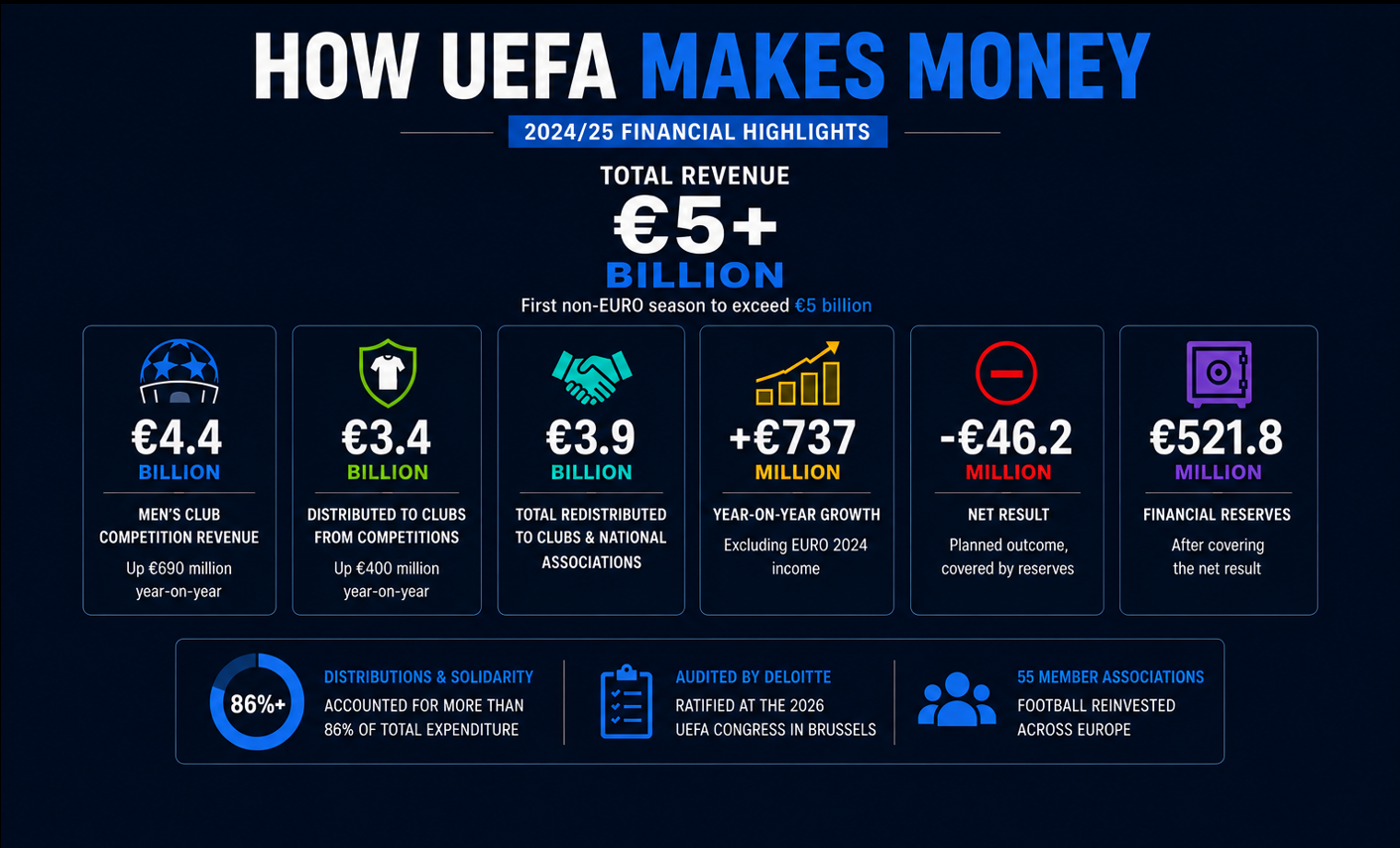
UEFA’s 2024/25 financial report, audited by Deloitte and ratified at the 2026 UEFA Congress in Brussels, set out the following:
- Total revenue: more than 5 billion euros — the first time UEFA has passed that mark in a non-EURO season, and 737 million euros up on 2023/24 when EURO 2024 income is excluded
- Men’s club competition revenue: 4.4 billion euros, up 690 million euros year on year
- Distributed to clubs from those competitions: 3.4 billion euros, up 400 million euros
- Total redistributed to clubs and national associations: 3.9 billion euros
- Net result: minus 46.2 million euros, covered by reserves as a planned outcome
- Reserves after that deduction: 521.8 million euros
How UEFA Makes Money
1. Men’s Club Competitions — the Engine
The Champions League, Europa League, Conference League and Super Cup generated 4.4 billion euros in 2024/25, roughly 85% of UEFA’s total. The jump was driven by the first season of the new-format club competitions, which added matches and increased the number of meaningful fixtures across the calendar.
UEFA sells these rights centrally: broadcasters and sponsors buy access to the whole competition rather than to individual clubs. That central model is what allows UEFA to redistribute the proceeds, and it is precisely the model that breakaway projects such as the Super League were designed to bypass.
2. National Team Competitions
The men’s EURO is UEFA’s single biggest event, but it lands only every four years — which is why 2024/25 looks unusually clean as a picture of the underlying club business. Between EUROs, the UEFA Nations League provides a steady income stream through centralised commercial rights, with shared sponsorship revenue expected to reach 3 billion euros between 2022 and 2028. That structure was designed to replace low-value friendlies with competitive matches that broadcasters will actually pay for.
3. Women’s, Youth and Development Competitions
Smaller commercially but growing. UEFA spent 71.4 million euros staging women’s, youth and development tournaments in 2024/25. The Under-21 EURO in Slovakia broke even for the first time on higher media, commercial and ticketing revenue. Women’s EURO 2025 income falls into the following reporting year.
Where the Money Goes
Prize Money and Performance Payments
Clubs receive money through a mix of participation fees, per-match performance bonuses, a value pillar reflecting broadcast market size, and a coefficient-based ranking component. In 2024/25 Paris Saint-Germain topped the list at 144.4 million euros, having won the first Champions League under the new format.
Solidarity Payments
UEFA commits 10% of gross competition revenue to solidarity. In 2024/25 that included 308 million euros to clubs that did not participate in European competition at all — a 76% increase on the previous figure — plus funding for clubs eliminated in qualifying and 25 million euros for the Youth League and women’s club competitions.
Grassroots and Development
UEFA spent 68.5 million euros on development programmes, education and grassroots support, including the Football in Schools programme, which it says has reached more than seven million children, and the UEFA Together initiative supporting football outside Europe.
Why UEFA’s Model Shapes Football Politics
Because almost all of UEFA’s income depends on the club calendar, anything that squeezes that calendar directly threatens its revenue. That is the structural reason European football pushed back so hard against FIFA’s expansion agenda and, in July 2026, against FIFA’s plan to sell a stake in its commercial business to private investors.
UEFA’s argument was straightforward: outside investors demanding a return would push for more FIFA matches and larger tournaments, taking dates and attention from the Champions League. With 4.4 billion euros a year riding on those competitions, the incentive to resist is obvious. We explain that clash in full in FIFA vs UEFA explained and the collapse of the deal in why FIFA cancelled its $20 billion World Cup investment plan.
UEFA vs FIFA: Two Different Businesses
| Category | Detail |
|---|---|
| Rhythm | UEFA earns every season; FIFA earns in a four-year spike around the World Cup |
| Scale | UEFA passed 5 billion euros in one season; FIFA’s full 2023-26 cycle came in around $13 billion |
| Reserves | UEFA holds about 522 million euros; FIFA holds roughly $4 billion |
| Philosophy | UEFA distributes almost everything annually; FIFA accumulates and grants |
| Dependence | UEFA depends on European clubs and broadcasters; FIFA depends on one tournament every four years |
For the other half of the picture, read how FIFA makes money.
What It Means If You Bet on European Football
UEFA’s financial structure has direct competitive consequences. Coefficient-based payments reward historic success, which entrenches the same clubs at the top and keeps outright markets short. The new league-phase format produces more matches between similarly ranked sides, which tends to compress prices and narrow the gap between favourite and underdog in the middle tier.
Practically, that means fewer obvious mispricings in headline markets and more value in secondary ones. If you are working through that, our guides to value betting, bookmaker margin and sports betting markets are the right starting points, and the dutching calculator is useful when a league phase leaves several plausible qualifiers.
Responsible Gambling
Betting should cost you no more than any other form of entertainment. Use deposit limits, take breaks, and contact the South African Responsible Gambling Foundation on 0800 006 008 or WhatsApp/SMS HELP to 076 675 0710 if it stops feeling like a choice.
Gambling is for adults aged 18 and over only. Please gamble responsibly.
Frequently Asked Questions
How much money does UEFA make per year?
More than 5 billion euros in 2024/25. Seasons containing a men’s EURO are higher still.
How much does a club earn from the Champions League?
It varies widely by performance, market and coefficient. In 2024/25, winners Paris Saint-Germain topped UEFA’s revenue list at 144.4 million euros.
Is UEFA a non-profit?
UEFA is an association that reinvests its income rather than paying shareholders. In 2024/25 it distributed 3.9 billion euros to clubs and national associations and posted a small planned deficit.
What are UEFA solidarity payments?
A fixed 10% of gross competition revenue paid to clubs and associations that do not take part in European competitions, designed to spread money down the football pyramid.
Sources
UEFA is a redistribution machine bolted onto the most valuable club competition in sport. It earns annually, spends almost everything it earns, and defends the calendar because the calendar is the product. Once you see that, every move it makes against FIFA becomes predictable.
Whichever competition you follow, bet within limits. Read our responsible gambling guide and, if you are in South Africa, our overview of South African gambling laws.
BettingGuru SA Disclaimer
BettingGuru SA is an independent sports betting review and information platform. This article is for informational and entertainment purposes only and is not a guarantee, betting instruction or financial recommendation. BettingGuru may receive commission from selected partners, but this does not influence editorial analysis. Gambling is for adults aged 18 and over only. Please gamble responsibly.